Author: Paul Austin-Menear

  • Stoking the Fire With Remarketing

    Stoking the Fire With Remarketing

    Stoking the Fire with Remarketing : How to Supercharge Your Paid Ads with Surgical Precision

    Remarketing—also known as retargeting—is one of the most powerful and precise tools in the digital advertiser’s toolkit. But it’s also one of the most misunderstood. In this post, we dive deep into how remarketing works, why it matters, and how you can use it to boost your ROI, extend campaign life, and support customer conversion with laser-targeted follow-ups.

    At its core, remarketing allows advertisers to show ads to people who have already engaged with their brand—whether by visiting a website, interacting with an app, or engaging with content. It works by placing cookies or using platform login data to track user behaviour and serve relevant ads across websites, apps, and devices. If you’ve ever felt like a brand was “following you around the web,” you’ve seen remarketing in action.

    But it’s not just creepy tech—it’s effective strategy. And when used thoughtfully, it can be a key part of a broader performance marketing mix.

    This article walks you through the technical underpinnings of remarketing, from cookie tracking to cross-device attribution and platform-level data sharing. We provide a real-world walkthrough of how a remarketing funnel works across websites and social media apps, plus insights into where remarketing fits within your paid advertising program.

    We also explore the practical limits of remarketing. Leaning on it too heavily can result in elevated customer acquisition costs, so it’s best used to amplify strong campaigns, close warm leads, or support list-building efforts.

    Whether you’re running remarketing campaigns through Google, Meta, or Amazon, or considering an outsourced partner, this post includes practical advice to ensure your spend aligns with your strategy. From audience segmentation to storytelling alignment, dayparting to frequency caps, and regional targeting to offer alignment, you’ll find a detailed guide to deploying remarketing with intention.

    And of course, it’s not just about conversion—it’s about building a sustainable system. The post includes advice on audience list building, impression pacing, and how to reduce the “creepy factor” of being ever-present in your prospect’s feeds.

    Download a free MER (Marketing Efficiency Ratio) tracking spreadsheet template to start modelling your performance.

    This isn’t a newsletter—it’s a builder’s field manual. Whether you’re bootstrapping a startup or refining a scaled growth system, remarketing can give your paid advertising the precision edge it needs.

    Read the full post or listen to the podcast edition here : https://6catalysts.substack.com/p/stoking-the-fire-with-remarketing

  • [Medium] Sparking the Fire with Affiliate Marketing

    [Medium] Sparking the Fire with Affiliate Marketing

    How performance-based marketing can help early-stage founders grow without blowing the budget


    You’ve just started building something new. From scratch. On a shoestring budget. With nothing but a dream, a domain, and maybe a cold cup of coffee.

    If that sounds like you, welcome. You’re not alone.

    Most founders feel a wave of panic at the idea of spending money on marketing in the early days. When cash is tight, every dollar feels precious — and every expense feels like a risk. I’ve been there, more than once.

    Even experienced entrepreneurs get caught in this loop. We hesitate. We delay. We default to resource-hoarding instead of taking action. We tell ourselves we’re being smart… but really, we’re often just scared of wasting money we don’t think we can afford to lose.

    That’s where affiliate marketing comes in.

    Not as a magic bullet—but as a reliable, repeatable way to spark the fire of your marketing system and start growing.

    What Is Affiliate Marketing, Really?

    Affiliate marketing is a form of performance-based marketing. You only pay when there’s a result.

    Instead of buying ad impressions or paying for clicks, you’re compensating partners for actual sales. It’s like the modern version of the old-school door-to-door salesperson—only now, your sales team can live anywhere in the world and promote your product 24/7.

    Here’s a basic example :

    • You offer an affiliate a 10% commission.
    • They drive a customer who buys $500 worth of your product.
    • You pay them $50 — after the sale closes and the funds clear.

    No clicks. No wasted impressions. Just outcomes.

    For an early-stage founder, that kind of risk mitigation is really valuable.

    The Three Layers of Affiliate Marketing

    To make affiliate marketing work, you need more than just an offer. You need a system. A way to recruit, support, and reward your partners.

    Let’s break it down.

    1. Partner Recruitment

    First, you’ve got to find the right people.

    They might be influencers, bloggers, creators, customers, or niche community leaders. Your ideal affiliates already have access to the audience you want to reach. But they need a reason to share your story.

    Recruitment takes effort. Outreach. Storytelling. Maybe even some pitching.

    Start with the people who already love what you’re building. Then widen the circle.

    2. Partner Support

    Once you’ve got their attention, help them succeed.

    What images, copy, links, or discount codes can you provide? Do you have an onboarding guide or affiliate toolkit? Will you give them early access to product drops or unique incentives?

    Treat affiliates like an extension of your marketing team. Because they are.

    The more equipped they are, the more sales they’ll drive.

    3. Attribution & Compensation

    Here’s where trust becomes essential.

    How will you track their referrals? How will you validate each sale? How quickly will you pay?

    There are plenty of platforms—ShareASale, CJ, Refersion, Referral Candy, and more — that can automate the heavy lifting. These tools plug into your website or eCommerce platform, track affiliate links, and streamline payouts.

    But you don’t need to go full-on tech stack on day one. I’ve run affiliate-style partnerships using nothing more than a coupon code field and a Google Sheet.

    Start simple. Scale smart.

    Why Affiliate Marketing Works for Bootstrapped Builders

    Let’s talk pros. Because affiliate marketing has a lot going for it—especially if you’re in the earliest phase of building.

    Low Upfront Cost : there’s no need to spend thousands upfront. You can get started with a basic setup or lean on existing tools with free tiers or low monthly fees.

    Low Financial Risk : You only pay after a sale. That makes it easier to experiment, test offers, and build momentum — without burning your budget.

    Leveraged Time : Create one set of assets — landing pages, banners, messaging — and reuse them across your entire affiliate network. Set it once, then watch it scale.

    Built-in Motivation : Affiliates are incentivized to succeed. Their success = your success.

    It’s a win-win.

    And the Tradeoffs? Let’s Be Honest.

    Affiliate marketing isn’t perfect. It’s a powerful tool, but like any activity, it comes with tradeoffs.

    Partner Recruitment Takes Time : You’re not just marketing to customers — you’re also marketing your affiliate program. That’s a whole second audience to reach and convert.

    Platform Fees Add Up : Many affiliate networks take a cut. You might pay 10% to the affiliate and another 5% to the platform — plus a monthly subscription. Model your margins carefully.

    Higher Costs at Scale : Over time, paying out commissions on every sale can be more expensive than running paid ads or growing your owned channels (like email).

    But that’s okay.

    Affiliate marketing isn’t meant to replace all your other tactics. It’s meant to help you start — to spark growth when other options are out of reach.

    Building a Self-Reinforcing Marketing System

    I’ve written before about the importance of self-reinforcing systems — where each marketing activity strengthens the others. Affiliate marketing plays beautifully into this concept.

    Here’s how :

    • Content Synergy—Repurpose your social media or blog content as swipe files for your affiliates.
    • Custom Landing Pages—Create pages that capture emails or SMS leads, converting high-cost affiliate traffic into low-cost owned audiences.
    • Exclusive Offers—Use affiliate-exclusive discount codes to deliver personalized, high-conversion offers (like an extra 5% off for a holiday promo).

    The goal is integration.

    Let your affiliate strategy amplify your other channels, not exist in isolation.

    Marketing works best when every part of the mix (product, price, placement, promotion, people) blends into a system that generates momentum.

    Think Long-Term : From Revenue to Relationship

    Here’s one final mindset shift.

    In the early days, affiliate marketing is about revenue acquisition—getting sales, fast, with low risk.

    But over time, the real value is in customer acquisition.

    That $50 commission you paid to earn a $500 sale? That’s a 10% cost of revenue.

    But what if that customer joins your newsletter? Buys again? Refers a friend? Spends $5,000 over the next three years?

    Now your cost of acquisition on that revenue drops to 1%.

    That’s the kind of math that makes investors—and founders—smile.

    Wrapping It All Up

    Affiliate marketing isn’t a silver bullet, but it is a solid match to light your first fire.

    • Low-risk? Check.
    • Easy to test? Yup.
    • Scales with you? Absolutely.

    Whether you’re running an eCommerce store, a digital service, or a niche SaaS platform—affiliate marketing can help you go from zero to first traction without breaking the bank.

    Use it well.

    Support your partners.

    Blend it into a broader system.

    And keep building.


    This article is a part of my series on topics for entrepreneurs, intrapreneurs, and people who just love building things. I podcast and post weekly with tools and guides on The Journey. Check out the companion piece here : https://6catalysts.substack.com/p/sparking-the-fire-with-affiliate-marketing

  • Feeding the Fire With Paid Advertising

    Feeding the Fire With Paid Advertising

    Paid digital advertising is often seen as the quick fix for business growth : fast, scalable, and accessible. But like fire, it needs to be carefully managed. This article explores how to integrate paid advertising into your marketing mix in a way that fuels growth without burning through your margins.

    Advertising isn’t new. Long before capitalism, humans bartered and promoted goods. In its modern form, advertising became widespread in the mid-20th century, and digital advertising as we know it emerged in the early 2000s. It’s a mature industry now, but one that primarily benefits platform owners—though businesses and consumers gain value too.

    Paid ads can play a crucial role in scaling. They’re the shortest path to new customers who have never heard of you but are ready to buy. Self-serve platforms like Google, Amazon, and Meta allow businesses to run campaigns directly, while managed solutions still exist for those who prefer agencies and media buyers. The real benefit is renting access to audiences someone else has already built.

    However, risks abound. Over-reliance on ads leads to ballooning Marketing Efficiency Ratios (MER), eroding long-term profitability. Worse, paid ads offer little residual value; once the campaign ends, the impact fades. Saturation also poses a major challenge: people quickly tune out ads, consciously or subconsciously. Attribution can be murky too, with impressions often recorded without meaningful engagement.

    That said, under-using ads slows growth and leaves you vulnerable to competitors who use them aggressively. The key is balance. Use paid advertising as a booster rocket, not your entire growth engine. Build your own audience in parallel—through email lists, newsletters, or community engagement—to reduce dependency on rented attention.

    Practical steps include setting up signup mechanisms on your website, offering incentives in paid ad funnels, and using frequency capping to limit waste. By capturing residual value and nurturing your own audience, you extend the life of every dollar spent on ads. Done right, this creates a resilient marketing mix that supports both immediate growth and long-term efficiency.

    Read the full post or listen to the podcast edition here : https://6catalysts.substack.com/p/feeding-the-fire-with-paid-advertising

  • [Medium] Being Green Without Greenwashing

    [Medium] Being Green Without Greenwashing


    Being Green Without Greenwashing

    How Startups Can Build Trust and Authenticity

    Building a brand is hard enough without extra baggage. But for founders creating purpose-driven businesses — especially those rooted in sustainability — the task gets heavier. Every story you tell, every promise you make, and every campaign you run comes with the risk of being dismissed as greenwashing.

    Daniel, a founder in Vancouver, recently asked me a great question :

    Marketing is something I’m struggling with. I don’t want to rely on discounting or “greenwashing” to build my startup’s brand. How can I tell our story in a way that’s authentic and builds a loyal customer base? I’m really stuck on how to use the ‘good’ parts of our sustainability philosophy without sounding insincere or preachy. Thanks, Daniel.

    It’s a question that matters far beyond his industry. Any brand anchored in values — whether that’s sustainability, equity, or purpose — will eventually face the same test : how do you balance mission with pragmatism?

    The answer requires us to break down greenwashing, look at the mechanics of trust, and explore practical strategies for building loyalty in a skeptical marketplace.

    The Greenwashing Trust Gap

    Let’s start with the obvious… greenwashing sucks.

    When brands exaggerate or fabricate claims about sustainability, they break trust. And once trust is broken, it’s almost impossible to restore. I’ve felt this personally — when I learn a brand has played fast and loose with its claims, I don’t just avoid their products in the future. I hold a grudge.

    What makes it worse is that dishonest players poison the well for everyone else. Consumers become skeptical. Even genuinely sustainable businesses are forced to work harder to “prove” themselves, often at greater cost and effort.

    Without consistent regulation or global standards, startups are left in a tough position : how do you prove your claims when the market has been taught to doubt them?

    Crossing the Adoption (Values) Chasm

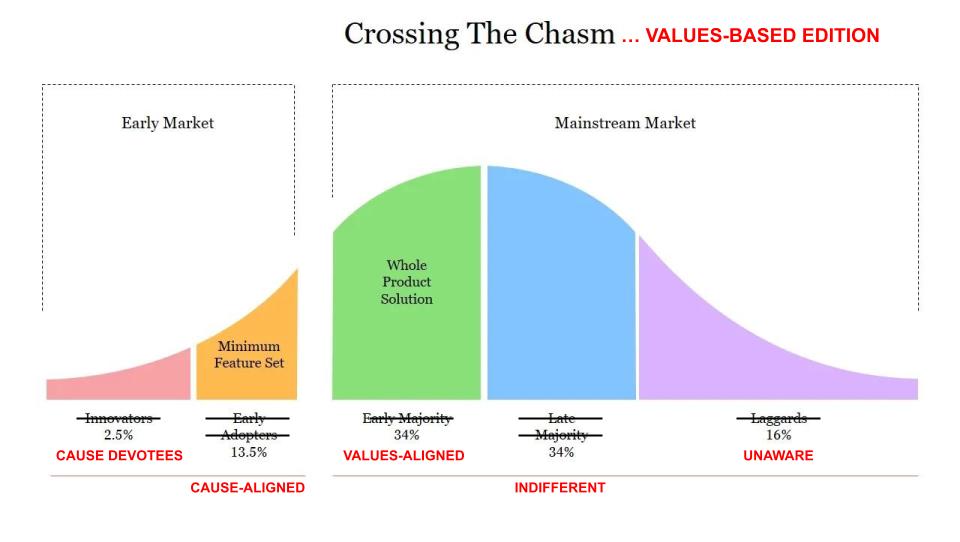
    The classic technology adoption curve chart, modified with segments for values-based adoption amongst customers.

    One useful framework comes from Crossing the Chasm, a classic on technology adoption. In the early days, purpose-driven brands attract the most passionate supporters — those devoted to the cause. They’re your early adopters.

    But if you want to grow, you can’t stop there. To move beyond the early market, you need to appeal to people who are only loosely aligned with your values. That’s the “chasm” you need to cross.

    This is where many sustainability-driven founders stumble. They assume everyone cares about their mission as much as they do. The reality? Many customers don’t. They’ll support your purpose if it’s a bonus, but they’re really shopping for performance, price, comfort, durability, or convenience.

    That doesn’t mean your mission doesn’t matter — it does. But to build a broader customer base, you need to translate purpose into product benefits. Does your use of ocean plastics make your gear stronger? Lighter? More affordable? Those attributes are what help you move from cause-driven enthusiasts to mainstream buyers.

    Trust Matters : The Role of Certification

    One of the best ways to avoid accusations of greenwashing is third-party validation. Certifications provide a layer of credibility that customers can lean on when they don’t have the time or expertise to evaluate your claims themselves.

    Some relevant examples :

    • ISO 14001:2015 (Environmental Management)
    • Forestry Stewardship Council (FSC) certifications
    • CAN/BNQ 3840–100 for recycled plastics content
    • Certified B Corporation

    These aren’t just logos for your website. They force you to build systems of transparency and accountability internally — systems that strengthen your brand over the long run.

    And they communicate to customers that you’re serious. When people see a B Corp or FSC mark, they know you’ve been tested against a standard higher than “we promise.”

    Why Discounting Is a Trap

    Daniel also asked about discounting. It’s tempting for new brands to run constant promotions to move product and attract buyers. But here’s the problem : discounting trains customers to expect lower prices.

    There’s a saying I first heard at McDonald’s while working as a university student : deal loyalty isn’t real loyalty.

    If customers are loyal to your discount, not your brand, you’ve created a fragile business model. They’ll buy when there’s a sale, and they’ll wait when there isn’t. That erodes margins and traps you in a cycle that’s tough to escape.

    Instead of blanket discounts, think about controlled strategies :

    • Private sales tied to loyalty programs
    • Exclusive events where high-value customers get early or special access
    • Tiered rewards based on customer lifetime value

    Handled carefully, these approaches let you clear inventory or reward loyalty without undermining your brand equity.

    Translating Purpose Into Benefits

    Sourcing ocean-recovered plastics is a powerful purpose. But purpose alone won’t carry you across the chasm. The next step is translating that mission into practical value for customers.

    Ask yourself :

    • Does this material create a stronger or longer-lasting product?
    • Is it more comfortable or stylish?
    • Does it offer cost savings compared to traditional inputs?
    • Can I pass those savings to customers — or hold prices steady while competitors increase theirs?

    The answers help you frame your marketing in ways that resonate beyond your core cause. They also prepare you for mainstream retail, where shoppers are making side-by-side comparisons on shelves.

    Systems for Transparency

    Greenwashing accusations often boil down to opacity. Customers feel they don’t know what’s really happening behind the curtain. Transparency fixes that.

    Consider publishing impact reports, opening up about supply chains, or even creating customer-facing dashboards that track your progress toward sustainability goals. Patagonia does this exceptionally well, but smaller brands can do it too with the right tools.

    Transparency doesn’t mean perfection. In fact, being honest about challenges or trade-offs can build more trust than pretending everything is flawless.

    The Two Unbreakable Rules

    At the end of the day, the rules for avoiding greenwashing and building loyalty are simple :

    1. When you make a claim, back it up with evidence.
    2. When you make a promise, keep it.

    Everything else — certifications, storytelling, community-building — is an extension of these two commitments. Follow them consistently, and you’ll build the kind of trust that converts into loyalty over years, not months.

    Final Thoughts

    Daniel’s challenge is one that every purpose-based founder will face : how do you avoid greenwashing while still leaning into your purpose?

    The path forward is clear :

    • Translate your mission into tangible product benefits.
    • Use certifications to add credibility.
    • Resist the trap of deal-driven branding.
    • Build systems of transparency.
    • And above all, keep promises and back up claims with proof.

    If you do these things, your brand won’t just avoid the pitfalls of greenwashing. It will stand out as a leader in authenticity — something customers are hungry for in a world full of empty claims.

    Being green without greenwashing isn’t easy. But the rewards — a loyal customer base, a resilient brand, and a business that lives its values — are worth the effort.


    This article is a part of my series on topics for entrepreneurs, intrapreneurs, and people who just love building things. I podcast and post weekly with tools and guides on The Journey. Check out the companion piece and podcast here : https://6catalysts.substack.com/p/ama-being-green-without-greenwashing

  • Canada’s Best fCSCO and fCLO Services

    Canada’s Best fCSCO and fCLO Services

    Six Catalysts Featured Among Canada’s Best Fractional Chief Supply Chain Officer and Chief Logistics Officer Services

    We are proud to share that Six Catalysts has been recognized by Digital Reference as one of the Best Fractional Chief Supply Chain Officer Services and Fractional Chief Logistics Officer Services in Canada.

    This feature is a meaningful validation of the transformational work we’re doing with mission-driven companies, SaaS innovators, energy leaders, and manufacturing organizations across the country.

    As a firm rooted in systemic thinking and executive alignment, we are honored to be spotlighted for our contribution to the future of supply chain and logistics leadership.

    Who We Serve and How We Work

    At Six Catalysts, we work with organizations seeking not just operational excellence but lasting transformation. From early-stage growth to scaling complexity, our clients turn to us when alignment, leadership, and change management are critical to success.

    We offer both project-based engagements and retained fractional executive roles, allowing us to embed with client teams as their outsourced or part-time Chief Supply Chain Officer (CSCO) or Chief Logistics Officer (CLO).

    Whether leading an ESG-focused redesign, restructuring global logistics, or coaching internal teams through strategic pivots, our strength lies in combining strategy with deep, human-centered execution. Learn more about our fractional CSCO and CLO services.

    The Role of Fractional CSCO and CLO Consultants Today

    Today’s supply chain and logistics challenges demand more than operational know-how. They require adaptive leadership, cross-functional coordination, and ESG integration at every level.

    That’s why Fractional Chief Supply Chain Officer Consultants and Fractional Chief Logistics Officer Specialists are playing an increasingly critical role in helping companies move faster, smarter, and more sustainably.

    If you’re exploring whether this model is right for your business, these two recent insights from Digital Reference are excellent starting points:

    These resources outline how specialized CSCO firms and CLO agencies deliver measurable results through agile, executive-level leadership without long-term overhead.

    Meet Our Founder : Leadership that Creates Lasting Change

    About Paul Austin-Menear

    At the heart of Six Catalysts is our founder, Paul Austin-Menear.

    Paul brings a rare combination of C-suite strategy, logistics expertise, and executive coaching to his work. With a background that spans systems thinking, cultural transformation, and operations leadership, Paul has guided both high-growth tech firms and legacy supply chain organizations through critical transitions.

    On LinkedIn and beyond, Paul is known for his thoughtful perspectives on systemic change, team dynamics, and the often-overlooked human side of logistics. His ability to lead through complexity makes him a trusted advisor for organizations navigating growth, disruption, or reinvention.

    Learn more about Paul and the Six Catalysts philosophy.

    Why This Recognition Matters

    Being featured by Digital Reference is not just a badge of honour—it’s a meaningful endorsement of our belief that fractional logistics and supply chain leadership can drive both performance and purpose.

    As more companies seek to embed ESG goals, align cross-functional teams, and rethink legacy operating models, our work sits at the intersection of strategy and sustainable change. This recognition affirms our role in that evolution.

    Ready to Connect?

    If you’re looking for fractional leadership that aligns operations with purpose, we’d love to start a conversation. Learn more about our services, or get in touch to explore how we can support your next phase of growth.


    About Digital Reference
    Digital Reference is a trusted editorial platform that spotlights top-performing fractional executives, consultants, and agencies across industries. Digital Reference is  on a mission to digitize the professional references process using a video resume tool that focuses on transparency, impact, and subject-matter expertise, Digital Reference helps businesses discover the right professionals to guide their next stage of growth. Explore more at digitalreference.co

  • [Medium] The Innovation Heartbeat

    [Medium] The Innovation Heartbeat

    The Innovation Heartbeat

    A Framework for Transforming Feedback to Insights

    Innovation. Few words in business carry as much baggage.

    It’s splashed across investor decks, marketing campaigns, and keynote speeches. It conjures up images of billion-dollar companies promising utopian futures : rockets to Mars, miracle drugs, AI revolutions. It’s become one of those flashy words that feels so overused it almost loses meaning.

    But here’s the truth : innovation doesn’t live only in those rarefied spaces. It isn’t limited to the domain of Silicon Valley titans, global pharma giants, or aerospace moonshots. Real innovation happens in everyday decisions, workflows, and problem-solving efforts. A process improvement that cuts wasted time? That’s innovation. A tweak to packaging that reduces errors? Innovation. A customer request turned into a new feature? Absolutely innovation.

    If that’s the case, why do so many organizations lose their innovative edge as they grow? Why do small, nimble startups brim with energy and creativity, while established organizations often feel like they’re stuck in slow motion?

    The answer is simple : ideas don’t disappear, but systems to process them break down.

    That’s where the Innovation Heartbeat comes in.

    It’s a framework designed to keep ideas circulating through your organization, just like blood circulates through the body. It ensures customer feedback, team suggestions, and everyday sparks don’t get lost but instead get refined and distributed into action.

    Innovation Is Everywhere

    Before we dive into the mechanics, let’s pause to reset our mental model of innovation.

    When your team is five people sitting around one table in a scrappy office above a coffee shop, innovation feels effortless. Someone says, “Hey, I was thinking…” and the conversation flows. Action happens quickly.

    As you scale, those conversations change. Teams specialize. Communication lines stretch. Priorities get stuck in silos. The urgency of execution crowds out the spark of ideas. The ecosystem that once carried ideas naturally starts to degrade.

    But innovation is not scarce. What’s scarce is the infrastructure to keep ideas alive.

    And here’s the shift : innovation has a supply chain, just like your products and services do.

    If you don’t build the pipes to move ideas around, they clog up. People stop sharing them. Execution carries on, but innovation slows down.

    The Innovation Heartbeat is that supply chain.

    The Framework in Three Phases

    The framework is straightforward : three phases that echo the way a human heart works.

    1. Pulse In : Reaching out to customers and gathering feedback.
    2. Fill & Process : Reviewing, filtering, and distilling feedback into insights.
    3. Pulse Out : Sharing those insights with stakeholders who can act on them.

    Let’s walk through each phase.

    Phase One : Pulse In

    The heartbeat starts with expansion. You open up, seeking signals from outside. In practice, this means building systems to collect customer feedback.

    Early on, that might mean sitting down for customer interviews, scanning support tickets, or picking up the phone. As you mature, automation becomes essential—surveys, feedback forms, in-product prompts, or tools like the Scalable Feedback Engine.

    The critical point here is consistency. Innovation thrives on rhythm. Without a steady inflow of signals, the system stalls.

    One word of caution : feedback collection must also respect customer privacy and choice. Regulations around personally identifiable information are evolving fast. More importantly, customers value companies that adopt a privacy-first mindset. Design your touchpoints in ways that invite openness, not suspicion.

    Phase Two : Fill & Process

    If Pulse In is about expansion, this phase is about circulation. Here, feedback enters the system and gets filtered into insights.

    Not all feedback is created equal. Some suggestions are directly actionable —change the way you package a product, fix a frustrating user interface. Others are guiding—signals about how well your company is meeting expectations, or where sentiment is shifting. Both types have value, but they play different roles.

    The Internal Champion — the person running the Innovation Heartbeat — leads this phase. Their job is to review, grade, and refine incoming feedback across four dimensions :

    1. Type : Is this actionable or guiding?
    2. Relevance : Does it align with the company’s mission, priorities, or customer focus?
    3. Impact : If implemented, how significant will the change be to customer experience?
    4. Difficulty : How complex would it be to execute the change?

    This grading system acts like gates in a pipeline. Weak ideas fall away; strong ideas advance. Some items may not be relevant today but are worth storing for later. The key is intentionality.

    Big ideas rarely survive this process unchanged — and that’s a good thing. They emerge sharper, contextualized, and ready for real impact.

    Phase Three : Pulse Out

    The final phase is contraction. This is where insights leave the center and move into the wider organization.

    Here’s the balancing act : while transparency is valuable, accountability matters even more. It’s tempting to dump insights into a shared folder or Slack channel and call it a day. But unless ownership is clear, nothing changes.

    The Internal Champion must not only distribute insights broadly but also hold purposeful conversations with stakeholders who can act. Marketing leaders may take one set of insights, product teams another. Each must know what they own and how to act on it.

    This is the critical transition : moving from raw ideas to real innovation.

    The Internal Champion : The Beating Heart

    At the center of this framework is the Internal Champion — the person who makes sure the heartbeat doesn’t falter.

    This role isn’t about seniority; it’s about capability and temperament. The most effective champions share four traits :

    • Intellectual Curiosity : A drive to dig into the “why” and connect dots others might miss.
    • Business Understanding : A working knowledge of products, services, and operations.
    • Communication Skills : The ability to translate feedback into insights people understand.
    • Tactful Assertiveness : Enough grit to advocate for customers, even when it’s unpopular.

    Champions don’t need to know how to do every specialized task. What matters is their ability to understand context and advocate across functions.

    If you find someone who fits this mold, protect and support them. They are rare — and they are catalysts for lasting innovation.

    Measuring the Heartbeat

    Like any system, the Innovation Heartbeat grows stronger when you measure it. Tracking the right metrics helps you refine and improve over time.

    Here are a few starters :

    • Time-to-Insight : How long does it take to turn feedback into a usable insight?
    • Conversion-to-Acceptance : What percentage of insights are adopted by stakeholders?
    • Time-to-Action : How long does it take to move from accepted insight to implemented change?
    • Grading Ratio : How many pieces of feedback does it take to generate one solid insight?
    • Customer Signal Trend : Are customer sentiment signals improving over time?

    These metrics don’t just measure speed or volume. They reveal where the system clogs and where it flows. Over time, they help you tune the Innovation Heartbeat to your organization’s unique rhythm.

    Why Start Early

    If building such a system sounds daunting, here’s the good news: it’s easier when your company is small.

    Large organizations often find meaningful change nearly impossible. Structures ossify. Politics creep in. Legacy systems resist new processes. By contrast, smaller companies can embed innovation into their DNA before complexity sets in.

    Think of it like fitness : it’s easier to build strength when you’re younger and more flexible. If you wait until later, the work is harder and the results slower.

    The Innovation Heartbeat is no different. Early adoption creates habits that scale with you.

    Innovation as a Competitive Moat

    Why does all this matter? Because innovation isn’t just a feel-good concept. It’s a competitive moat.

    Organizations that nurture curiosity, collect signals, and act on them consistently will outperform those that don’t. They’ll be faster, more responsive, and more in tune with customer needs.

    And the moat grows over time. Each cycle strengthens the system, making it harder for competitors to catch up.

    That’s why the Innovation Heartbeat is worth the investment. It’s not about chasing hype. It’s about creating an unfair advantage — one insight at a time.

    Putting It Into Practice

    Theory only takes you so far. That’s why I’ve built a free planning tool that helps you generate a tailored Innovation Heartbeat plan for your organization.

    It’s simple : answer a few questions about your size and resources, and the tool generates a plan. No data is saved, so you can answer freely. You can email yourself the output and start putting it into action right away.

    It takes about ten minutes — and it’s free. Your success is worth more to me than a few dollars. Get started here.

    Final Thoughts

    Innovation isn’t magic. It isn’t reserved for billion-dollar companies. It’s a discipline — a system that ensures ideas don’t die on the vine but flow into action.

    The Innovation Heartbeat provides that system. Pulse In. Fill & Process. Pulse Out.

    If you start small, measure consistently, and empower the right champion, innovation becomes more than a buzzword. It becomes part of your organization’s rhythm.

    And in the long run, that rhythm may be the strongest competitive advantage you can build.

    This article is a part of my series on topics for entrepreneurs, intrapreneurs, and people who just love building things. I podcast and post weekly with tools and guides on The Journey. Check out the companion piece here : https://6catalysts.substack.com/p/the-innovation-heartbeat

  • Sparking the Fire with Affiliate Marketing

    Sparking the Fire with Affiliate Marketing

    Sparking the Fire with Affiliate Marketing

    When you’re building from scratch with limited capital, the idea of spending on marketing can feel more like gambling than investing. That’s why affiliate marketing—a performance-based model where you only pay when a sale closes—can be a powerful tool for early-stage founders.

    This post breaks down the affiliate model, explains how it works, and outlines the systems you need in place for recruiting partners, managing attribution, and making payouts. It also highlights the pros (low risk, low time cost) and the cons (long-term efficiency, network fees) so you can make informed choices.

    You’ll also get practical advice for blending affiliate marketing with your broader marketing mix—creating synergy, boosting ROI, and using affiliate strategies as both a revenue and customer acquisition tool.

    Read the full post or listen to the podcast edition here : https://6catalysts.substack.com/p/sparking-the-fire-with-affiliate-marketing

  • [MEDIUM] HOLY <BLEEP> : A Guide to Sales Forecasting

    [MEDIUM] HOLY <BLEEP> : A Guide to Sales Forecasting

    HOLY <BLEEP> : A Guide to Sales Forecasting

    Sales forecasting gets a bad rap. People call economics “the dismal science,” but if you’ve ever sweated over a quarterly sales forecast spreadsheet, you know forecasting deserves that crown.

    For many builders, it’s as nerve-wracking as public speaking. You dread it, you avoid it… until you’ve done it enough times to realize it won’t actually kill you. Like stepping on stage, the fear is mostly in the anticipation. The first time, your palms sweat. The second time, you’re still uneasy. By the tenth time, you start to notice patterns—and maybe even enjoy the craft.

    But forecasting for a business, especially if you make tangible products, is more than a comfort-building exercise. It’s a critical function that ties directly to your cash flow, inventory, and operational efficiency. It’s the Goldilocks problem in business operations: not too much, not too little, but just right. And getting there is hard.

    Even giant corporations with decades of experience, mountains of historical data, and advanced software tools routinely get it wrong. That’s why industries exist to deal with overstock—companies like Winners and Marshalls (TJX Group) or Liquidation World (LW Stores) profit from excess inventory created by forecasting misses.

    So, if the pros still struggle, how do you, the builder of a small but growing business, approach forecasting in a way that’s practical, effective, and doesn’t drain your will to live?

    Let’s start with the basics.


    What Forecasting Actually Is

    At its core, sales forecasting—also called demand forecasting—is making an educated bet on how many things your customers will buy in the future. You use that bet to place orders with suppliers, schedule production runs, or coordinate with a contract manufacturer (also called a co-packer) to make finished goods.

    It sounds simple enough, but in practice, it’s anything but. Forecasting requires balancing multiple variables: market demand, production capacity, seasonality, promotions, competitor activity, and your own risk tolerance.

    Forecasting accuracy is important because it directly impacts your most precious resources: time and money. A good forecast helps you optimize both.


    Why Forecasting Is Hard—and Why It Matters

    Forecast too low, and you risk running out of stock, losing sales, and frustrating customers. Forecast too high, and you tie up cash in unsold inventory that could have been invested elsewhere.

    Some leaders swear it’s better to under-forecast, keeping inventory lean to protect the cash conversion cycle. Others insist over-forecasting is safer, ensuring you never miss a sale. I think both views miss the point. Obsessing over whether you’re slightly over or under is less useful than creating a rational, data-informed process—and then setting guardrails so your worst-case scenario doesn’t sink you.

    Forecasting isn’t about perfection. It’s about creating a repeatable, adaptable system.


    The Three Main Forecasting Approaches

    Every forecast falls into one of three broad categories :

    1. Causal modelling — Looking at cause-and-effect factors that influence demand. This includes macroeconomic conditions (“Is the economy in recession?”) and micro factors (“We’re running a 20% off sale this month”). Price elasticity studies also fall here.
    2. Qualitative modelling — Using non-statistical information to build a picture of demand. This could be market research, surveys, or brand loyalty studies.
    3. Time-series modelling — Using your own historical demand data to predict future sales.

    For early-stage builders of tangible goods, time-series modelling is usually the most accessible and immediately useful approach. You don’t need a PhD in econometrics or expensive software—just a spreadsheet, some data, and a clear process.


    Four Time-Series Models You Can Start Using Today

    1. Historical Comparison

    The simplest method of all. Look at a comparable past period and assume you’ll sell the same amount in the future.

    If you sold 228 widgets in January this year, you forecast 228 for January next year. It’s quick, but it’s also blunt—it ignores growth, market changes, and promotional plans.

    Even with its limitations, historical comparison is foundational. It’s one of the few truly “known” data points you have.

    See an example here.


    2. Moving Average (MA)

    The moving average method smooths out short-term fluctuations to give a clearer view of overall trends. It’s more nuanced than a straight historical comparison because it reduces the impact of outlier months.

    Here’s how to build it:

    • Gather a year of sales data, broken down by time period (monthly is common).
    • Calculate the average for three consecutive periods (e.g., the last three months).
    • Use that three-period average as your forecast for the next period.

    This approach reduces volatility, but it still doesn’t account for predictable seasonal swings.

    See an example here.


    3. Seasonally-Adjusted Moving Average (SAMA)

    SAMA adds a layer to your moving average to capture predictable demand spikes or dips—like holiday shopping surges or summer slowdowns.

    To build it :

    • Identify recurring seasonal patterns in your sales data.
    • Calculate your moving average.
    • Determine the percentage lift or drop in sales during seasonal periods compared to non-seasonal ones.
    • Adjust your forecast accordingly.

    If you’re using a year-over-year historical comparison, seasonality is already baked in (though not as precisely as when you calculate it directly).

    See an example here.


    4. Exponentially-Smoothed Bursting

    This model is particularly useful for businesses that see intense demand spikes from promotions, PR pushes, or product launches—and for situations where you don’t have much historical data.

    The idea is to create a “demand curve” based on past bursts and apply it to future events.

    Steps :

    • Identify past bursts of activity and gather sales data for the periods before, during, and after.
    • Calculate your baseline sales.
    • Determine the sales lift (delta) during and after each burst.
    • Apply these lift percentages to forecast future bursts.

    This approach blends the smoothing benefits of moving averages with targeted adjustments for short-term, high-intensity demand patterns.

    See an example here.


    What If You Don’t Have Historical Data?

    Time-series models depend on past data. But what if you’re launching a new product or business and don’t have any?

    If you have a similar product, you can use its historical data as a proxy, adjusting for differences in audience, price point, or use case.

    If you have nothing, base your forecast on financial risk :

    • How much capital can you commit to production without jeopardizing your ability to try again if sales flop?
    • How confident are you in your product-market fit?
    • How deep are you willing to discount to move product if needed?

    Essentially, you work backwards from your risk tolerance. If you have $10,000 in operating capital and want to keep $5,000 in reserve, you produce as many units as the other $5,000 will buy. Launch, measure, adapt, repeat.


    The Continuous Improvement Mindset

    The most common forecasting mistake? Treating it as a static process. Businesses rarely track their forecast accuracy over time. They miss the opportunity to learn from misses and improve the model.

    Your forecasting process should evolve with your business. That means :

    • Reviewing actuals vs. forecasts regularly.
    • Identifying which models work best for which products.
    • Adjusting for new patterns as your business and market change.

    Even small improvements compound over time, boosting both your bottom line and your operational confidence.


    Forecasting as a Builder’s Superpower

    Forecasting isn’t glamorous. It doesn’t give you the immediate dopamine hit of closing a sale or launching a product. But it’s one of the most powerful tools in your operational toolbox.

    When done well, it frees up mental space. You’re not constantly scrambling to react to stockouts or overstock—you have a plan, and you trust the system you’ve built.

    That’s the real goal here : not perfection, but predictability. Not clairvoyance, but clarity.

    The best part? You can start today with nothing more than your sales data and a spreadsheet. Pick a model, apply it, measure your results, and keep refining. Over time, you’ll turn forecasting from a sweaty-palmed chore into a core strength of your business.


    This article is a part of my series on topics for entrepreneurs, intrapreneurs, and people who just love building things. I podcast and post weekly with tools and guides on The Journey. Check out the companion piece here : https://6catalysts.substack.com/p/holy-bleep-a-guide-to-sales-forecasting

  • From Culinary Roots to Cultural Creator : Phil Bean on Craft, Confidence, and Publishing

    From Culinary Roots to Cultural Creator : Phil Bean on Craft, Confidence, and Publishing

    In this episode of The Journey : In Conversation, we sit down with Phil Bean—author, father, and creator of things—to explore the evolution of a creative journey that began in kitchens and led to bookshelves.

    Phil shares how blogging during his solo travels in China sparked a lifelong creative practice. From navigating the publishing world with a rhyming children’s book to learning how to balance artistic integrity with the realities of self-promotion, Phil offers vulnerable and insightful reflections on how to just start—and how to keep going.

    We explore :

    • Why accountability to strangers can be more motivating than feedback from friends
    • The 80% rule, and why perfectionism kills momentum
    • What it really takes to self-publish a book (spoiler : it’s more than writing)
    • How kids, collaborators, and creative tools (even AI!) can help unblock your brain
    • The difference between writing for yourself and writing for recognition

    This episode is a must-watch for anyone considering making the leap into writing, blogging, or publishing. Phil’s message? Do it for you—and don’t wait for permission.

    Read the full post or listen to the podcast edition here : https://6catalysts.substack.com/p/in-conversation-with-phil-bean

  • AMA : Being Green Without Greenwashing

    AMA : Being Green Without Greenwashing

    This month’s AMA tackles a question from Daniel in Vancouver, who’s building a sustainable outdoor gear brand that uses ocean-recovered plastics. His concern? How to tell a values-based brand story authentically—without greenwashing, discounting, or sounding preachy.

    We dig into why trust matters more than “green” labels, how to cross the chasm from purpose-driven early adopters to mainstream customers, and why deal loyalty isn’t real loyalty. You’ll also find practical strategies like pursuing third-party certifications, designing transparency systems, and thinking creatively about how to discount without hurting your brand.

    The result is a roadmap for staying authentic while building a sustainable business customers can believe in.

    Read the full post or listen to the podcast edition here : https://6catalysts.substack.com/p/ama-being-green-without-greenwashing