
Author: Paul Austin-Menear

  • [Medium] The Paradox of Success : Why Customers Fall Out of Love With Growing Brands

    [Medium] The Paradox of Success : Why Customers Fall Out of Love With Growing Brands

    Why Customers Fall Out of Love With Growing Brands

    A hot new startup forms, creates something that people love, and grows like crazy. It feels like everyone is talking about them, and the future seems bright.

    Inside that company, things are exciting. And extremely chaotic — keeping up with explosive growth is a hard thing to manage.

    Businesses which find their footing and grow like this often follow a familiar cycle when they get to their product/market fit inflection point. I’ve closely observed dozens which have gone through it over the course of my career.

    The cycle usually goes something like this :

    1 | Founder-led or exec-led teams explore and experiment, searching for the thing that sticks — and talk to customers relentlessly. They fold in that feedback, and iterate rapidly to improve upon what they’re doing.

    2 | The business finds market fit and the thing that sticks. Hooray! Big problem solved. Teams now have some certainty about what’s ahead and can plan, then build. The future becomes less foggy, and less scary. But more daunting.

    3 | The founder or execs turn their attention to growing capacity and scaling the business, and stop talking to customers with the same urgency and purpose. There are only so many hours in the day.

    Some do continue to engage directly with customers, but there always comes a point in scaling where demands on time mean that founders and senior leaders can’t do this as much or as well as they did in the early days when finding the thing that sticks was all that mattered.

    4 | Efforts to build capacity refocus on strengthening typical business-critical functions : demand-generation, production scaling, supply chain/service delivery, and structures to manage and grow staff headcount.

    Sometimes, talking to customers is wedged into the bucket of marketing activities at this stage. Sometimes it’s forgotten about entirely. After all, market fit was uncovered — what more is there to do that involves talking to customers in a purposed, structured way?

    5 | The business grows — through ups and downs — slowly becoming more disengaged from customers (especially as the volume of customers grows). As the months and years go on, staff positions turn over and are filled with people who lack the context of the early days and the relentless focus on customers. Often, these new staff are also missing the original purpose of the brand — the magical belief in the mission that helped coax the best out of everyone on the team.

    6 | Eventually, something changes* with the market or customer base. It catches the business off-guard, and leadership and key stakeholders scramble to course-correct. Maybe it was competition. Maybe it was a changing customer base. Maybe it was an unintended shift in purpose or values that created misalignment with staff, with customers, or both. Revenues start to decline, but overhead doesn’t. Ut-oh.

    The key thread in this cycle is that the voice of the customer eventually becomes lost in the noise that accompanies rapid growth. What founders and senior execs who find themselves in this position often neglect to do is preserve the importance of talking to customers in their company culture. They may have been great at it, but the individuals and teams who follow in their footsteps may not be (or may not even realize how important this is when it comes to sustaining innovation). Another key standout in this cycle is the distinction between customer service and customer insights. They’re not the same thing, though sometimes the assumption is that they easily could be (or should be).

    OK, but what’s the paradox?

    As the business finds success and begins to grow, it loses sight of how it became successful in the first place because it stops proactively seeking customer feedback. And, is then less able to replicate that success when the initial shine wears off.

    * Something Changes.

    This will happen, whether the business had maintained strong engagement with customers or not. The difference though, is that businesses which maintain strong customer engagement are better prepared when change comes, because there were warning signs that change was coming. Informed leaders are leaders who panic less, and teams that are informed are able to adapt with purpose rather than with knee-jerk reactions and guessing-games.

    The Voice of the Customer

    The voice of the customer is a colloquialism for understanding your customers’ wants and needs, and bringing the related feedback into the business in a way that creates advocacy for those wants and needs.

    A part of the antidote for the paradox of success involves creating a structured, systemic approach to place the voice of the customer within the key action zones of your business (the intersections where it will drive innovation and positive change). The approach that you use to solidify the voice of the customer within your business needs to be robust enough to stand on its own when the founder(s) or execs start to focus their attention to scaling up.

    This means that the right technology tools need to be built into your operations stack — but also the right supporting processes. And perhaps most critically of all, a champion needs to be chosen who will advocate for the customer throughout the business and spearhead efforts to engage with, understand, and distill both insights and opportunities from your interactions with customers.

    Choosing Your Champion

    Having the right person slotted into the role of champion for the customer is crucial for the success of building a Scalable Feedback Engine which delivers intelligence and the catalysts for innovation throughout the business.

    What I’ve found from working with effective champions over the years is that there’s no one-size-fits-all definition. There are, after all, many roads you can take to get to your destination. However, the most effective champions share these characteristics :

    • Strong critical thinking skills
    • Strong research and analytical skills
    • An adept, self-driven relationship builder
    • A self-motivated learner who doesn’t need to wait to be shown how to do things
    • A communication style that leans on both efficiency and empathy
    • An insatiable, intellectual curiosity and a drive to uncover hidden truths

    And it certainly doesn’t hurt if your champion is a product expert (though product expertise also naturally develops in a role like this).

    Understanding “Customer Research”

    There’s an entire industry that exists to perform customer research. And market research. And market insights. And customer insights. The terms sound the same, but they’re different — from the outcomes you’ll get from them to how you go about it.

    First, let’s set a metaphor to orient ourselves — imagine a vast beach by the ocean, with people walking the sands and seashells dotting the shoreline. Instead of thinking of this as a tourist’s paradise, let’s think of it as a system with different parts and roles.

    A customer is a buyer of certain goods or services, which creates demand for those goods or services (buyers who want them). With enough demand, there is sufficient opportunity for many firms to compete to win that business from customers. In our metaphor, the customers are the people walking up and down the beach, looking for seashells.

    A supplier is a producer and/or seller of these goods or services, and suppliers exist to get a piece of the action (economists call this “capturing demand”). In our metaphor, think of a supplier as an individual seashell. There are many seashells on the beach, representing many suppliers competing for customers to pick them and make a purchase (taking a seashell from the beach).

    A market is a collection of competing firms supplying similar goods or services which can satisfy that customer demand. In our metaphor, the market is the section of sand and water where the seashells can be found.

    An economy is the collection of different markets where customers and suppliers interact to create and satisfy demand (sell and buy). In our metaphor, think of the economy as a zoomed out view of the world where all of the beaches are separate markets — each with different characteristics (size, location, colour of sand, types of shells) and customers (nationality, language, and varying desire for seashells or other things found on the beach).
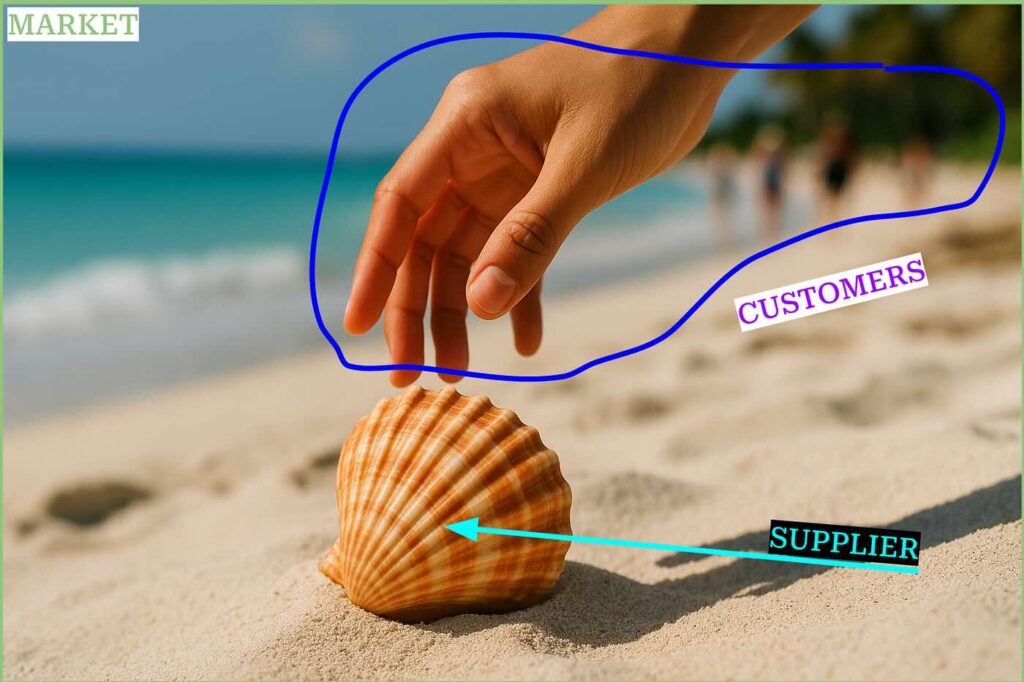
    There’s more nuance to it than this, but you get the idea.

    Bringing it back to our efforts to understand customers, the different types of research activities line up with the above.

    Customer research seeks to understand the needs, characteristics, and behaviour of the customers of a given supplier. Insights is the term applied to the usable information that comes from this research. So, customer insights are the learnings which can be acted upon.

    Market research seeks to understand the needs, characteristics, and behaviour of the market itself — the interactions between the suppliers and customers, and the constraints or characteristics of all of the commercial activity which takes place within it. In our metaphor, market research would be the attempt to understand the sandy beach with the seashells as a whole system instead of the individual wants of the individual people picking seashells from that breach.

    Economic research seeks to understand the very high-level view of how different markets overlap and interact with each other (macroeconomics does, anyway). It’s the 100,000 foot view of all of these market-based interactions.

    Economic research is almost never conducted by suppliers, it’s too broad in scope to justify using the resources of an individual supplier — thus economic research tends to come from universities, governmental organizations, and think tanks.

    Market research tends to be conducted by organizations that specialize in it, both public sector and private sector. This type of research is also generally too broad for an individual supplier to engage in it.

    Customer research is usually performed by an individual supplier (or by another specialized firm on behalf of the supplier). I generally advocate for customer research to be conducted in-house, so that it remains close to the operational action zones of the company as it scales. Though, a model where an external firm conducts the research at the direction of a single point of contact inside the company can work too — especially if that same person takes ownership of refining the insights and assertively disseminating them as actionable information to different parts of the organization.

    Fighting Off the Paradox of Success

    Let’s tie everything together.

    Giving your business a better shot at fighting off the paradox of success means preserving the place which the customer has within the organization — keeping their wants and needs central to your operations. A manageable way to do this as you grow as by creating a Scalable Feedback Engine, and installing a champion to harness that engine and nurture innovation in the organization by carrying the engine’s outputs to key stakeholders.

    What’s that mean in practice?

    1. Choose and empower a champion.
    2. Design and deploy a research stack.
    3. Use your research stack to engage with customers and collect feedback.
    4. Distill the feedback into actionable insights and disseminate them through the organization.

    This doesn’t mean that every insight generated from the Scalable Feedback Engine has to be actioned. Some insights may not be viable as a part of your product/service or process. That’s OK — the real value of maintaining a well-oiled program is that it structurally encourages awareness and greater understanding of your customer throughout the organization.

    In turn, this will catalyze innovation in unexpected ways. And that’s a critical part of preserving your competitive moat as the business grows.

    Want an actionable, step-by-step look at how to create a Scalable Feedback Engine in your organization? Check out my companion post, “Building a Scalable Feedback Engine from Scratch” on The Journey : https://6catalysts.substack.com/p/two-tin-cans-and-a-string.


  • Working ON the Business

    Working ON the Business

    The Case for Builders to Zoom Out, Once in Awhile

    Running a business doesn’t always mean you’re building it. In this post, we break down the classic phrase “Work on the business, not in the business” and show you how to actually do both. Learn why treating your company as a product leads to smarter growth, how to apply customer-centric thinking to your internal team, and what time segmentation can do for your strategic momentum.

    Don’t miss the guiding questions and the teaser on SMARTER goals to help you structure your next step.

    Read the full post or listen to the podcast edition here : https://6catalysts.substack.com/p/working-on-the-business-new

  • The Paradox of Success : Why Customers Fall Out of Love With Growing Brands

    The Paradox of Success : Why Customers Fall Out of Love With Growing Brands


    A hot new startup forms, creates something that people love, and grows like crazy. It feels like everyone is talking about them, and the future seems bright.

    Inside that company, things are exciting. And extremely chaotic — keeping up with explosive growth is a hard thing to manage.

    Businesses which find their footing and grow like this often follow a familiar cycle when they get to their product/market fit inflection point. I’ve closely observed dozens which have gone through it over the course of my career.

    The cycle usually goes something like this :

    1 | Founder-led or exec-led teams explore and experiment, searching for the thing that sticks — and talk to customers relentlessly. They fold in that feedback, and iterate rapidly to improve upon what they’re doing.

    2 | The business finds market fit and the thing that sticks. Hooray! Big problem solved. Teams now have some certainty about what’s ahead and can plan, then build. The future becomes less foggy, and less scary. But more daunting.

    3 | The founder or execs turn their attention to growing capacity and scaling the business, and stop talking to customers with the same urgency and purpose. There are only so many hours in the day.

    Some do continue to engage directly with customers, but there always comes a point in scaling where demands on time mean that founders and senior leaders can’t do this as much or as well as they did in the early days when finding the thing that sticks was all that mattered.

    4 | Efforts to build capacity refocus on strengthening typical business-critical functions : demand-generation, production scaling, supply chain/service delivery, and structures to manage and grow staff headcount.

    Sometimes, talking to customers is wedged into the bucket of marketing activities at this stage. Sometimes it’s forgotten about entirely. After all, market fit was uncovered — what more is there to do that involves talking to customers in a purposed, structured way?

    5 | The business grows — through ups and downs — slowly becoming more disengaged from customers (especially as the volume of customers grows). As the months and years go on, staff positions turn over and are filled with people who lack the context of the early days and the relentless focus on customers. Often, these new staff are also missing the original purpose of the brand — the magical belief in the mission that helped coax the best out of everyone on the team.

    6 | Eventually, something changes* with the market or customer base. It catches the business off-guard, and leadership and key stakeholders scramble to course-correct. Maybe it was competition. Maybe it was a changing customer base. Maybe it was an unintended shift in purpose or values that created misalignment with staff, with customers, or both. Revenues start to decline, but overhead doesn’t. Ut-oh.

    The key thread in this cycle is that the voice of the customer eventually becomes lost in the noise that accompanies rapid growth. What founders and senior execs who find themselves in this position often neglect to do is preserve the importance of talking to customers in their company culture. They may have been great at it, but the individuals and teams who follow in their footsteps may not be (or may not even realize how important this is when it comes to sustaining innovation). Another key standout in this cycle is the distinction between customer service and customer insights. They’re not the same thing, though sometimes the assumption is that they easily could be (or should be).

    OK, but what’s the paradox?

    As the business finds success and begins to grow, it loses sight of how it became successful in the first place because it stops proactively seeking customer feedback. And, is then less able to replicate that success when the initial shine wears off.

    * Something Changes.

    This will happen, whether the business had maintained strong engagement with customers or not. The difference though, is that businesses which maintain strong customer engagement are better prepared when change comes, because there were warning signs that change was coming. Informed leaders are leaders who panic less, and teams that are informed are able to adapt with purpose rather than with knee-jerk reactions and guessing-games.

    The Voice of the Customer

    The voice of the customer is a colloquialism for understanding your customers’ wants and needs, and bringing the related feedback into the business in a way that creates advocacy for those wants and needs.

    A part of the antidote for the paradox of success involves creating a structured, systemic approach to place the voice of the customer within the key action zones of your business (the intersections where it will drive innovation and positive change). The approach that you use to solidify the voice of the customer within your business needs to be robust enough to stand on its own when the founder(s) or execs start to focus their attention to scaling up.

    This means that the right technology tools need to be built into your operations stack — but also the right supporting processes. And perhaps most critically of all, a champion needs to be chosen who will advocate for the customer throughout the business and spearhead efforts to engage with, understand, and distill both insights and opportunities from your interactions with customers.

    Choosing Your Champion

    Having the right person slotted into the role of champion for the customer is crucial for the success of building a Scalable Feedback Engine which delivers intelligence and the catalysts for innovation throughout the business.

    What I’ve found from working with effective champions over the years is that there’s no one-size-fits-all definition. There are, after all, many roads you can take to get to your destination. However, the most effective champions share these characteristics :

    • Strong critical thinking skills
    • Strong research and analytical skills
    • An adept, self-driven relationship builder
    • A self-motivated learner who doesn’t need to wait to be shown how to do things
    • A communication style that leans on both efficiency and empathy
    • An insatiable, intellectual curiosity and a drive to uncover hidden truths

    And it certainly doesn’t hurt if your champion is a product expert (though product expertise also naturally develops in a role like this).

    Understanding “Customer Research”

    There’s an entire industry that exists to perform customer research. And market research. And market insights. And customer insights. The terms sound the same, but they’re different — from the outcomes you’ll get from them to how you go about it.

    First, let’s set a metaphor to orient ourselves — imagine a vast beach by the ocean, with people walking the sands and seashells dotting the shoreline. Instead of thinking of this as a tourist’s paradise, let’s think of it as a system with different parts and roles.

    A customer is a buyer of certain goods or services, which creates demand for those goods or services (buyers who want them). With enough demand, there is sufficient opportunity for many firms to compete to win that business from customers. In our metaphor, the customers are the people walking up and down the beach, looking for seashells.

    A supplier is a producer and/or seller of these goods or services, and suppliers exist to get a piece of the action (economists call this “capturing demand”). In our metaphor, think of a supplier as an individual seashell. There are many seashells on the beach, representing many suppliers competing for customers to pick them and make a purchase (taking a seashell from the beach).

    A market is a collection of competing firms supplying similar goods or services which can satisfy that customer demand. In our metaphor, the market is the section of sand and water where the seashells can be found.

    An economy is the collection of different markets where customers and suppliers interact to create and satisfy demand (sell and buy). In our metaphor, think of the economy as a zoomed out view of the world where all of the beaches are separate markets — each with different characteristics (size, location, colour of sand, types of shells) and customers (nationality, language, and varying desire for seashells or other things found on the beach).

    There’s more nuance to it than this, but you get the idea.

    Bringing it back to our efforts to understand customers, the different types of research activities line up with the above.

    Customer research seeks to understand the needs, characteristics, and behaviour of the customers of a given supplier. Insights is the term applied to the usable information that comes from this research. So, customer insights are the learnings which can be acted upon.

    Market research seeks to understand the needs, characteristics, and behaviour of the market itself — the interactions between the suppliers and customers, and the constraints or characteristics of all of the commercial activity which takes place within it. In our metaphor, market research would be the attempt to understand the sandy beach with the seashells as a whole system instead of the individual wants of the individual people picking seashells from that breach.

    Economic research seeks to understand the very high-level view of how different markets overlap and interact with each other (macroeconomics does, anyway). It’s the 100,000 foot view of all of these market-based interactions.

    Economic research is almost never conducted by suppliers, it’s too broad in scope to justify using the resources of an individual supplier — thus economic research tends to come from universities, governmental organizations, and think tanks.

    Market research tends to be conducted by organizations that specialize in it, both public sector and private sector. This type of research is also generally too broad for an individual supplier to engage in it.

    Customer research is usually performed by an individual supplier (or by another specialized firm on behalf of the supplier). I generally advocate for customer research to be conducted in-house, so that it remains close to the operational action zones of the company as it scales. Though, a model where an external firm conducts the research at the direction of a single point of contact inside the company can work too — especially if that same person takes ownership of refining the insights and assertively disseminating them as actionable information to different parts of the organization.

    Fighting Off the Paradox of Success

    Let’s tie everything together.

    Giving your business a better shot at fighting off the paradox of success means preserving the place which the customer has within the organization — keeping their wants and needs central to your operations. A manageable way to do this as you grow as by creating a Scalable Feedback Engine, and installing a champion to harness that engine and nurture innovation in the organization by carrying the engine’s outputs to key stakeholders.

    What’s that mean in practice?

    1. Choose and empower a champion.
    2. Design and deploy a research stack.
    3. Use your research stack to engage with customers and collect feedback.
    4. Distill the feedback into actionable insights and disseminate them through the organization.

    This doesn’t mean that every insight generated from the Scalable Feedback Engine has to be actioned. Some insights may not be viable as a part of your product/service or process. That’s OK — the real value of maintaining a well-oiled program is that it structurally encourages awareness and greater understanding of your customer throughout the organization.

    In turn, this will catalyze innovation in unexpected ways. And that’s a critical part of preserving your competitive moat as the business grows.


    Want an actionable, step-by-step look at how to create a Scalable Feedback Engine in your organization? Check out my companion post, “Building a Scalable Feedback Engine from Scratch” on The Journey : https://6catalysts.substack.com/p/two-tin-cans-and-a-string.

  • Testing Ideas : The Market-Maker Method

    Testing Ideas : The Market-Maker Method

    Testing Ideas: The Market-Maker Method

    When your idea is high-stakes and you need serious confidence in its viability, it’s time to go beyond basic surveys or brainstorms. The Market-Maker Method is a hands-on approach that simulates a product launch before anything is actually built. It’s ideal for innovative ideas with no clear market comparables and those that require education or behaviour change.

    This method involves creating a complete marketing campaign—landing pages, media assets, pricing tests, and promotional content—and measuring how real users respond. Whether you use platforms like Kickstarter or build a private test via paid ads on your own site, the result is actual behavioural data that tells you whether your idea has legs.

    Yes, it’s the most resource-intensive of the four methods we’ve covered. But it’s also the most accurate.

    Learn how to plan, launch, and measure your Market-Maker simulation in our full guide—and hear it discussed in our podcast companion episode.

    Read the full post + listen to the podcast now : https://6catalysts.substack.com/p/testing-ideas-the-market-maker-method-new

  • Tariff Tantrums : Minimizing the Cashflow Smackdown from Uncle Sam’s New Import Tax

    Tariff Tantrums : Minimizing the Cashflow Smackdown from Uncle Sam’s New Import Tax

    Ouch.

    This week’s surprise tariff hike has global brands scrambling to recalculate. With US import duties now soaring as high as 50%, how you warehouse and distribute your goods matters more than ever.

    In our latest post, we analyze three warehousing strategies—US-based, Canada-based, and Mexico-based—plus a hybrid option. We weigh the pros and cons of each approach in the context of cashflow, duty exposure, and delivery timelines.

    You’ll also get access to a free modelling tool to simulate how each option affects your bottom line based on your products’ landed costs and volumes.

    Highlights include:

    • The real story behind who pays tariffs (hint: it’s not the manufacturer)
    • How USMCA/CUSMA can work to your advantage
    • Why warehousing in Canada or Mexico might be the smarter bet
    • What the death of Section 321 means for your low-value shipments

    If your business sells into the US market, this post is essential reading. Visit the full article to download the tool and take action before the tariffs take a bite out of your margins.

    Read the post or listen to the podcast edition here : https://6catalysts.substack.com/p/tariff-tantrums-minimizing-the-cashflow-new

  • Testing Ideas : The Customer-Centric Method

    Testing Ideas : The Customer-Centric Method

    Go Make Some Friends : A Hands-On Method for Validating Ideas

    Sometimes, the best way to know if your idea has legs is to walk it right out the door.

    This week’s feature from The Journey dives into a street-level customer validation method that prioritizes real conversations over digital dashboards. Whether you’re crafting a new product or refining a pitch, talking directly to potential customers—especially those unfamiliar with your business—can uncover powerful insights.

    You’ll learn:

    • How to plan and execute purposeful customer outreach
    • Tips for building trust and gathering authentic feedback
    • The pros and cons of in-person validation
    • Why this method is more than just feedback—it’s also marketing

    If you’ve ever wanted a no-fluff, high-impact way to test your spark of inspiration, this is the one to try.

    You can read the full post and listen to the podcast edition here : https://6catalysts.substack.com/p/testing-ideas-the-customer-centric-new

  • Testing Ideas : The Alignment Method

    Testing Ideas : The Alignment Method

    Validating Ideas by Playing Make Believe

    Imagine a future where your idea wins.

    Some of the best ideas fail—not because they’re bad—but because they’re never validated properly. Enter The Alignment Method, a collaborative exercise that brings together a diverse group to answer a powerful question: What would have to be true for this idea to be the best choice for the customer?

    Unlike traditional critique-based validation, The Alignment Method is a constructive, imagination-based method that aligns stakeholders without unnecessary conflict. It works equally well for internal initiatives or customer-facing ideas, and is especially useful in leadership or strategy retreats.

    In this post, we outline everything you need to run an alignment construct session—from preparation to execution to analysis. It’s a low-cost, high-value way to test whether your spark deserves fuel.

    You can read the full guide or listen to the podcast episode here : https://6catalysts.substack.com/p/testing-ideas-the-alignment-method-new

  • The Contrarian Method – How to Validate Ideas by Tearing Them Down

    The Contrarian Method – How to Validate Ideas by Tearing Them Down

    Validating a new idea doesn’t have to be expensive—or even time-consuming. Sometimes the best way to test a concept is to attack it yourself, deliberately. This week on The Journey, we explore “The Contrarian Method”—a structured devil’s advocate approach that helps entrepreneurs refine their thinking, uncover blind spots, and build better ideas.

    In our latest podcast episode and companion post, you’ll learn:

    • What you need to run a contrarian session
    • Step-by-step instructions for executing it
    • The pros and cons of this method
    • Why AI tools might not be the best devil’s advocate

    This method is ideal as a first validation step—especially before investing in market research or development. But beware: it’s not a substitute for customer feedback.

    Listen to the episode and read the companion post here : https://6catalysts.substack.com/p/testing-ideas-the-contrarian-method-updated?r=289rpl

  • AMA : Cocktail Kits for the Sober Curious

    AMA : Cocktail Kits for the Sober Curious

    Every month, I select a few Ask-Me-Anything submissions and post a direct response on The Journey with advice and practical approaches. It’s a bit like ‘Dear Abbey’, but for builders with a headache.

    Need some advice?

    When early interest doesn’t convert to purchases, is it a traffic problem—or a market fit issue?

    In this week’s edition of The Journey, we answer a real-world question from a DTC founder in Prague whose zero-proof cocktail subscription box is struggling to convert interest into revenue.

    We break down how to:

    • Benchmark conversion rates and diagnose traffic issues
    • Rethink pricing through the lens of value perception
    • Identify value-added services that justify your price point
    • Know when to iterate vs. when to pivot

    Read the full post or listen to the podcast edition here : https://6catalysts.substack.com/p/ama-cocktail-kits-for-the-sober-curious