Tag: Medium Post

Crossposting of content on Medium for non-subscribers.

  • [Medium] Does LinkedIn Hate Substack?

    [Medium] Does LinkedIn Hate Substack?


    The question sounds dramatic, but creators who publish consistently on LinkedIn eventually run into the same friction point : posts with links seem to perform worse. It’s become almost folk wisdom. Experienced users have internalized the rule. Newer users are taught it. And creators who rely on LinkedIn for distribution quietly accept the reality that every outbound link feels like a tax.

    But folk wisdom isn’t data. And platform behaviour doesn’t always match the tidy hypotheses we come up with to explain it. So when a Substack Note from writer JHong pointed out that “link in comments” has become basically invisible — and that including the link in the main post was the only real way to get clicks — it raised a more interesting question. If link placement matters, does link destination matter too?

    For someone publishing simultaneously on Substack and a LinkedIn Newsletter, that question isn’t academic. It affects distribution, visibility, strategy, and growth. And it’s a question worth testing instead of speculating.

    Why LinkedIn Might Penalize Links in the First Place

    To understand any modern feed algorithm, you need to understand how the business behind it makes money. LinkedIn is, above everything else, an advertising platform. Yes, it sells subscriptions. Yes, it offers hiring tools and premium features. But the bulk of its revenue still comes from selling targeted ad impressions. That means one metric matters more than anything else: time spent on-site.

    Any link that takes someone away from the feed interrupts the behaviour LinkedIn is optimized to monetize. So if the platform deprioritizes posts with links — especially links to other publishing platforms like Substack — it’s acting rationally within its incentives. A link is a potential leak in the revenue model.

    But not all links are equal, which is where the real question emerges. Does LinkedIn treat a link to its own ecosystem (a LinkedIn Newsletter article) differently than a link that directs a user to a completely external platform like Substack?

    I designed a two-week experiment to find out.

    How the Experiment Worked

    For fourteen days, three posts were published each day :

    1. A control post with no link at all.
    2. A post linking to the LinkedIn-hosted version of an article.
    3. A post linking to the Substack-hosted version of the same article.

    The posts were kept as similar as possible : same topics, same visual structure, similar tone, and the same posting window each day. The idea wasn’t to measure clicks or conversions, that wasn’t the concern. The only question was : Which posts does LinkedIn show to people?

    The metric of interest was impressions — the number of times each post appeared in a user’s feed.

    The Results, and Why They’re Interesting

    If the intuition behind link penalties is correct, the control posts should perform best. And they did, but the scale of the difference was surprising.

    Across the test period :

    • Control posts generated 140% more impressions than posts linking to LinkedIn Newsletter articles.
    • LinkedIn-linked posts only slightly outperformed Substack-linked posts (493 vs. 436 impressions).
    • The gap between the two link types was small enough that it’s hard to claim any real advantage for on-site links.

    What surprised me most wasn’t that links depress reach, but that LinkedIn’s own Newsletter feature didn’t receive preferential treatment. If anything, the platform treated both link types similarly, suggesting that the act of clicking itself — on-site or off-site — interrupts the feed enough to trigger lower distribution.

    From the platform’s perspective, it makes sense. Even an on-site click disrupts scrolling behaviour, which weakens the core ad-driven engine. The feed is the product. Anything that pulls a user out of that rhythm becomes a liability.

    Behavioural Trends Worth Noting

    Beyond link performance, the dataset surfaced a few patterns that matter for creators :

    • Wednesdays performed best, generating 24% more impressions than any other day.
    • Morning posts outperformed afternoon posts by about 17%.
    • Posts with two or more reactions tended to accelerate, confirming the widely observed snowball effect of engagement.

    None of these patterns should be generalized too aggressively… audiences differ, routines differ, and LinkedIn’s algorithm is dynamic. But the trends are directionally useful and reinforce an important reality : most distribution problems are behavioural, not algorithmic.

    What Builders Should Take Away From This

    If your primary goal is reach, removing links is the simplest way to improve post visibility. If your goal is traffic, then links are necessary, but you should rely on them strategically rather than by default.

    The real value of this experiment isn’t the specific numbers. It’s the reminder that attention platforms optimize for themselves, not for creators. And if you want to build an audience that compounds, you’re better off understanding the underlying incentives than guessing at the shadows cast by the algorithm.


    This article is a part of my series on topics for entrepreneurs, intrapreneurs, and people who just love building things. I podcast and post weekly with tools and guides on The Journey. Check out the companion piece here : https://6catalysts.substack.com/p/does-linkedin-hate-substack

  • [Medium] Measuring the Flames : Marketing Analytics for Builders (Part 2)

    [Medium] Measuring the Flames : Marketing Analytics for Builders (Part 2)

    If you’ve ever opened Google Analytics and felt your pulse quicken, you’re not alone. Today’s marketing tools give us more data than ever — but also more confusion. The problem isn’t a lack of information. It’s that most builders haven’t been taught how to interpret what they see.

    Marketing analytics, when done right, aren’t about collecting every possible data point. They’re about focusing on the ones that directly connect to business outcomes. Builders who learn to measure what matters transform analytics from noise into navigation.

    At its heart, marketing analytics is about alignment. Every business has its unique mix of activities — ads, email campaigns, product launches, community engagement — and each should serve a purpose. When you tie your metrics to your marketing mix (the Five Ps) and your funnel or flywheel model, you stop reacting to numbers and start directing them.

    The funnel represents Awareness, Consideration, and Conversion. It’s where prospects move from discovery to decision. The flywheel — Attract, Convert, Retain, Create — recognizes that growth isn’t linear. Loyal customers drive momentum, fuelling new opportunities through advocacy.

    They’re not competing models — they’re complementary lenses. The funnel fits within the flywheel’s Convert stage, giving you both tactical and strategic clarity.

    So, how do you build a measurement program that serves you rather than the other way around?

    1. Start by mapping your funnel and flywheel.
    2. Identify your marketing activities under each stage.
    3. Define how you’ll measure success for each activity.
    4. Collect data for a few months.
    5. Set goals based on your baseline and refine over time.

    When it comes to metrics, simplicity beats sophistication. Start with the essentials : Conversion Rate, Marketing Efficiency Ratio, Cost per Lead, Customer Lifetime Value, and Net Promoter Score. Each reveals something about how effectively your marketing drives awareness, revenue, and loyalty.

    But don’t stop there. Builders are problem-solvers — and sometimes, the metric you need doesn’t exist yet. Create your own. Custom metrics let you measure behaviour that’s specific to your customers and your goals.

    Consider the example of a small coffee chain that noticed customers who ordered a drip coffee and baked good often bought a bag of beans to take home. They created a custom metric — the Combo-to-Bagged-Bean Ratio — to track the relationship between in-store pairings and take-home sales. By quantifying that pattern, they could test promotions, adjust displays, and measure progress toward a 1:1 ratio.

    Measurement is a feedback loop. The more clearly you define what you’re measuring, the better you can improve it.

    In the end, analytics isn’t about being data-driven — it’s about being decision-driven. Builders who know what they’re measuring, and why, make smarter moves faster.

  • [Medium] Stoking the Fire With Remarketing

    [Medium] Stoking the Fire With Remarketing

    Stoking the Fire with Remarketing : How to Use it to Win Smarter, Not Louder

    When it comes to digital advertising, the loudest voice doesn’t always win. The most efficient campaigns are often those that know when to speak, to whom, and why. This is where remarketing — sometimes called retargeting — comes into play. It’s not about casting a wider net. It’s about knowing exactly where the fish are and dropping the line at the perfect moment.

    Let’s break it down.

    What is Remarketing?

    If you’ve ever visited a website, clicked around, then left — only to suddenly see that brand’s ads follow you across the internet — you’ve already experienced remarketing.

    Remarketing is the practice of showing ads to people who have already interacted with your brand in some way. This interaction could be a page visit, a form fill, a video view, or even just scrolling through a product page. The idea is simple : remind them you exist and nudge them toward taking a next step.

    But the mechanism isn’t magic. It’s tracking.

    How Does Remarketing Work?

    Digital behaviour is trackable — often to an unsettling degree. Devices, browsers, and platforms leave trails. Cookies, pixels, and login sessions capture and correlate activity across apps and devices.

    When a visitor lands on your website or app, a cookie (a small file) is placed in their browser. Think of it like a little digital paintball — something that stays on the user until it expires, gets deleted, or is overwritten. Now, that cookie can be recognized by advertising networks (like Google, Meta, or Amazon) when the same user visits other websites or platforms within that network.

    This allows advertisers to selectively serve ads to users who have shown interest, regardless of where they are online — reading the news, checking email, or scrolling social media. And if those users are logged in across multiple devices? The tracking — and ad targeting — can follow them across smartphones, tablets, and desktops.

    The Role of Remarketing in the Marketing Mix

    Remarketing falls within the Promotion category of the marketing mix, but it’s more of a highlighter than a headline.

    Used well, it reinforces your message and drives conversion. Used poorly, it drives up your cost-per-acquisition and annoys your audience.

    The key is to layer it into a broader strategy, not rely on it exclusively. Remarketing is ideal for amplifying your best-performing content or following up on warm leads. For example, if a video ad on YouTube is generating strong engagement, you might follow up with remarketing display ads that tell the next chapter of the story.

    Common Pitfalls to Avoid

    Too often, businesses over-rely on remarketing and burn their budgets doing so. Here are common mistakes :

    • Too much frequency : Seeing the same ad 15 times in a day doesn’t convert — it irritates.
    • Poor segmentation : Treating all visitors the same leads to wasted spend. Someone who bounced after 3 seconds should not be treated the same as someone who abandoned their cart.
    • Geographic mismatch : Don’t spend money on countries you don’t serve.
    • Lack of storytelling : Showing the same creative over and over won’t move the needle. Follow up with new angles, new incentives.

    Getting Started: Self-Serve and Agency Models

    If you’re new to remarketing, the easiest way to start is through self-serve ad platforms:

    • Google Ads offers remarketing across Search, Display, and YouTube.
    • Meta Ads (Facebook and Instagram) allows for pixel-based remarketing and custom audience creation.
    • Amazon Ads includes options for sellers and brands with retail footprints.

    Specialized agencies also offer full-serve retargeting solutions, but tread carefully. Not all agencies are created equal. You’re not buying a service — you’re hiring a growth partner. Do your due diligence, check references, and treat it like a major hire.

    Tactical Guidelines for Smarter Remarketing

    To use remarketing wisely, follow these proven strategies :

    • Segment your audiences : Target only those who engaged deeply — product viewers, cart abandoners, or email clickers.
    • Limit impression frequency : Set caps on how often someone sees your ad per day or per week.
    • Use narrative sequencing : Show different ads in a series — introduce, inform, incentivize.
    • Optimize for time of day : If your customers shop at night, don’t waste money advertising in the morning.
    • Align messaging with source behaviour : If someone watched a product video, follow up with a discount on that specific product.
    • Build owned audiences : Push toward email, SMS, or WhatsApp list capture. These channels are far cheaper long term.
    • Model your performance : Use tools like MER (Marketing Efficiency Ratio) to track returns over time. Don’t guess — measure.

    Final Thoughts : Precision Over Volume

    Remarketing isn’t about adding more volume. It’s about applying precision to your existing funnel. It’s your chance to connect again with someone who already knows you — and maybe just needs the right nudge to say yes.

    Used correctly, remarketing extends your brand presence and strengthens your conversion rate. But you have to respect the boundaries of the tactic.

    Don’t just follow your audience around the internet. Offer them a better reason to come back.

  • [Medium] Feeding the Fire With Paid Advertising

    [Medium] Feeding the Fire With Paid Advertising

    Paid digital ads are convenient — but come at a cost when you over-rely on them

    Paid advertising is one of the most tempting tools available to entrepreneurs. It promises fast growth, measurable results, and scalable reach. But like any powerful tool, it comes with risks. Used carelessly, it can erode profitability and leave your business vulnerable. Used wisely, it can spark growth while helping you build systems that sustain success long after the campaign ends.

    In this article, I’ll unpack the good, the bad, and the downright ugly sides of paid advertising. I’ll also share a practical framework for how to blend ads into your marketing mix in a way that fuels growth without leaving you dependent on a tactic that can easily burn out.

    The Long History of Advertising

    Advertising is as old as commerce itself. Long before capitalism, people were promoting goods and services — whether it was a farmer shouting about fresh produce at a market or a craftsman hanging a sign outside his workshop.

    Modern advertising took shape in the mid-20th century, when print, radio, and eventually television became the dominant channels. Then, in the early 2000s, paid digital advertising emerged. Google’s AdWords (now Google Ads), Amazon’s sponsored listings, and Meta’s ecosystem of Facebook and Instagram ads rewrote the playbook.

    What was once limited to large corporations with big budgets became accessible to anyone with a credit card. Self-serve platforms eliminated many of the intermediaries. Suddenly, the small coffee shop down the street could compete for attention alongside Fortune 500 brands.

    Advertising has always been about attention. But in the digital age, you’re not just competing for attention — you’re renting it. And that’s where the tension begins.

    The Good : Why Paid Advertising Works

    The biggest advantage of paid advertising is obvious: instant access to an audience.

    When you pay for an ad, you’re essentially renting someone else’s distribution. A platform has already done the hard work of gathering users. You plug in your budget, craft your message, and get in front of those eyeballs (or ears).

    This makes paid ads one of the fastest ways to scale. Unlike organic marketing, which requires patience and persistence, ads can deliver immediate results. A new business can go from zero awareness to generating its first sales in a matter of days.

    Paid advertising also comes with built-in support. On the managed end of the spectrum, agencies and media buyers offer creative development and placement services. On the self-serve end, digital platforms provide dashboards, targeting tools, and analytics to empower business owners directly.

    For many businesses, paid ads are the first taste of predictable customer acquisition. When it works, it feels like flipping a switch that floods your funnel with opportunity.

    The Bad : Where the Shine Wears Off

    Here’s the problem… ads aren’t free.

    And while that sounds obvious, the costs are more than just what you pay upfront. Paid ads come with almost no residual value. Once the campaign ends, the impact fades. The sales stop flowing. Unlike content, community, or owned channels, there’s no compounding effect.

    You’re renting attention, not owning it. The moment you stop paying rent, you’re out on the street.

    This creates a treadmill effect. You keep spending to keep results coming in. And if your costs rise — because of higher ad prices, increased competition, or external pressures like tariffs or inflation — your margins get squeezed.

    Another risk is over-reliance. Many businesses fall in love with the quick results of ads and neglect other channels. The Marketing Efficiency Ratio (MER) — a measure of how much you spend to acquire revenue — often balloons over time, eating into profitability.

    Paid advertising will almost always work to some degree. The trouble starts when it stops working as efficiently, and you don’t have other systems in place to pick up the slack.

    The Ugly : Saturation and Attribution

    The word advertisers dread most? Saturation.

    Humans adapt quickly to repeated stimuli. Psychologists call it sensory adaptation. Play music on a long road trip, and over time you’ll unconsciously turn the volume up. Ads work the same way. The more we see them, the more our brains tune them out.

    This is why so many people scroll past banner ads or mentally skip over parts of webpages where ads live. You may still be paying for impressions, but those impressions don’t necessarily equal engagement.

    Attribution adds another layer of complexity. Platforms often count an impression simply because an ad loaded — even if the user never scrolled down far enough to see it. Some platforms have improved, counting only when an ad enters the viewport. But even then, you can’t guarantee someone cognitively registered your message.

    The saturation effect erodes effectiveness. Meanwhile, murky attribution makes it harder to trust the numbers you’re given. This combination is what makes advertising “the ugly” in many marketing budgets.

    A Smarter Way Forward : Paid Ads as a Booster Rocket

    So, should you abandon paid advertising? Absolutely not. The key is to use it strategically — as a booster rocket, not the entire engine.

    Think back to the marketing mix. Paid ads belong in the “Promotion” category. They’re one tactic among many. If they dominate your mix, you’re at risk. If they complement other efforts, you’re stronger.

    The real secret is capturing residual value. Don’t just run ads for the sake of immediate sales. Use them as a bridge to build your own audience. That means collecting email addresses, SMS numbers, or other direct contact information.

    Why? Because once you own the relationship, there’s no middleman charging you rent. You can nurture, educate, and sell to your audience on your own terms.

    Practical Tips for Getting Started

    1. Set up owned channels first.
    2. Add mechanisms to collect email addresses, phone numbers, or signups to your website. A simple newsletter signup form is a great place to start.
    3. Pair ads with incentives.
    4. If someone clicks through from a paid ad, give them a reason to stay connected. Offer a discount, bonus, or piece of exclusive content in exchange for joining your list.
    5. Use frequency capping.
    6. Don’t bombard the same person with endless impressions. Set a limit. If they haven’t engaged after multiple exposures, you’re wasting money.
    7. Run nurturing campaigns.
    8. Use your email or SMS channels to deepen relationships. Share useful content, follow up with relevant offers, and personalize based on customer behaviour.
    9. Measure and rebalance.
    10. Track your Marketing Efficiency Ratio. If it starts climbing too high, rebalance your marketing mix. Ads should fuel your system, not define it.

    The Entrepreneur’s Takeaway

    Paid advertising is a tool, not a silver bullet. Treat it like fire : powerful when contained, destructive when unchecked.

    The businesses that thrive are those that blend paid ads into a broader system. They use ads to accelerate momentum while simultaneously building channels they own. Over time, this reduces dependency, lowers acquisition costs, and creates resilience against competition and market shifts.

    So yes, run ads. But also build systems. Rent attention in the short term, while investing in relationships that last. That’s how you keep feeding the fire without getting burned.

  • [Medium] Sparking the Fire with Affiliate Marketing

    [Medium] Sparking the Fire with Affiliate Marketing

    How performance-based marketing can help early-stage founders grow without blowing the budget


    You’ve just started building something new. From scratch. On a shoestring budget. With nothing but a dream, a domain, and maybe a cold cup of coffee.

    If that sounds like you, welcome. You’re not alone.

    Most founders feel a wave of panic at the idea of spending money on marketing in the early days. When cash is tight, every dollar feels precious — and every expense feels like a risk. I’ve been there, more than once.

    Even experienced entrepreneurs get caught in this loop. We hesitate. We delay. We default to resource-hoarding instead of taking action. We tell ourselves we’re being smart… but really, we’re often just scared of wasting money we don’t think we can afford to lose.

    That’s where affiliate marketing comes in.

    Not as a magic bullet—but as a reliable, repeatable way to spark the fire of your marketing system and start growing.

    What Is Affiliate Marketing, Really?

    Affiliate marketing is a form of performance-based marketing. You only pay when there’s a result.

    Instead of buying ad impressions or paying for clicks, you’re compensating partners for actual sales. It’s like the modern version of the old-school door-to-door salesperson—only now, your sales team can live anywhere in the world and promote your product 24/7.

    Here’s a basic example :

    • You offer an affiliate a 10% commission.
    • They drive a customer who buys $500 worth of your product.
    • You pay them $50 — after the sale closes and the funds clear.

    No clicks. No wasted impressions. Just outcomes.

    For an early-stage founder, that kind of risk mitigation is really valuable.

    The Three Layers of Affiliate Marketing

    To make affiliate marketing work, you need more than just an offer. You need a system. A way to recruit, support, and reward your partners.

    Let’s break it down.

    1. Partner Recruitment

    First, you’ve got to find the right people.

    They might be influencers, bloggers, creators, customers, or niche community leaders. Your ideal affiliates already have access to the audience you want to reach. But they need a reason to share your story.

    Recruitment takes effort. Outreach. Storytelling. Maybe even some pitching.

    Start with the people who already love what you’re building. Then widen the circle.

    2. Partner Support

    Once you’ve got their attention, help them succeed.

    What images, copy, links, or discount codes can you provide? Do you have an onboarding guide or affiliate toolkit? Will you give them early access to product drops or unique incentives?

    Treat affiliates like an extension of your marketing team. Because they are.

    The more equipped they are, the more sales they’ll drive.

    3. Attribution & Compensation

    Here’s where trust becomes essential.

    How will you track their referrals? How will you validate each sale? How quickly will you pay?

    There are plenty of platforms—ShareASale, CJ, Refersion, Referral Candy, and more — that can automate the heavy lifting. These tools plug into your website or eCommerce platform, track affiliate links, and streamline payouts.

    But you don’t need to go full-on tech stack on day one. I’ve run affiliate-style partnerships using nothing more than a coupon code field and a Google Sheet.

    Start simple. Scale smart.

    Why Affiliate Marketing Works for Bootstrapped Builders

    Let’s talk pros. Because affiliate marketing has a lot going for it—especially if you’re in the earliest phase of building.

    Low Upfront Cost : there’s no need to spend thousands upfront. You can get started with a basic setup or lean on existing tools with free tiers or low monthly fees.

    Low Financial Risk : You only pay after a sale. That makes it easier to experiment, test offers, and build momentum — without burning your budget.

    Leveraged Time : Create one set of assets — landing pages, banners, messaging — and reuse them across your entire affiliate network. Set it once, then watch it scale.

    Built-in Motivation : Affiliates are incentivized to succeed. Their success = your success.

    It’s a win-win.

    And the Tradeoffs? Let’s Be Honest.

    Affiliate marketing isn’t perfect. It’s a powerful tool, but like any activity, it comes with tradeoffs.

    Partner Recruitment Takes Time : You’re not just marketing to customers — you’re also marketing your affiliate program. That’s a whole second audience to reach and convert.

    Platform Fees Add Up : Many affiliate networks take a cut. You might pay 10% to the affiliate and another 5% to the platform — plus a monthly subscription. Model your margins carefully.

    Higher Costs at Scale : Over time, paying out commissions on every sale can be more expensive than running paid ads or growing your owned channels (like email).

    But that’s okay.

    Affiliate marketing isn’t meant to replace all your other tactics. It’s meant to help you start — to spark growth when other options are out of reach.

    Building a Self-Reinforcing Marketing System

    I’ve written before about the importance of self-reinforcing systems — where each marketing activity strengthens the others. Affiliate marketing plays beautifully into this concept.

    Here’s how :

    • Content Synergy—Repurpose your social media or blog content as swipe files for your affiliates.
    • Custom Landing Pages—Create pages that capture emails or SMS leads, converting high-cost affiliate traffic into low-cost owned audiences.
    • Exclusive Offers—Use affiliate-exclusive discount codes to deliver personalized, high-conversion offers (like an extra 5% off for a holiday promo).

    The goal is integration.

    Let your affiliate strategy amplify your other channels, not exist in isolation.

    Marketing works best when every part of the mix (product, price, placement, promotion, people) blends into a system that generates momentum.

    Think Long-Term : From Revenue to Relationship

    Here’s one final mindset shift.

    In the early days, affiliate marketing is about revenue acquisition—getting sales, fast, with low risk.

    But over time, the real value is in customer acquisition.

    That $50 commission you paid to earn a $500 sale? That’s a 10% cost of revenue.

    But what if that customer joins your newsletter? Buys again? Refers a friend? Spends $5,000 over the next three years?

    Now your cost of acquisition on that revenue drops to 1%.

    That’s the kind of math that makes investors—and founders—smile.

    Wrapping It All Up

    Affiliate marketing isn’t a silver bullet, but it is a solid match to light your first fire.

    • Low-risk? Check.
    • Easy to test? Yup.
    • Scales with you? Absolutely.

    Whether you’re running an eCommerce store, a digital service, or a niche SaaS platform—affiliate marketing can help you go from zero to first traction without breaking the bank.

    Use it well.

    Support your partners.

    Blend it into a broader system.

    And keep building.


    This article is a part of my series on topics for entrepreneurs, intrapreneurs, and people who just love building things. I podcast and post weekly with tools and guides on The Journey. Check out the companion piece here : https://6catalysts.substack.com/p/sparking-the-fire-with-affiliate-marketing

  • [Medium] Being Green Without Greenwashing

    [Medium] Being Green Without Greenwashing


    Being Green Without Greenwashing

    How Startups Can Build Trust and Authenticity

    Building a brand is hard enough without extra baggage. But for founders creating purpose-driven businesses — especially those rooted in sustainability — the task gets heavier. Every story you tell, every promise you make, and every campaign you run comes with the risk of being dismissed as greenwashing.

    Daniel, a founder in Vancouver, recently asked me a great question :

    Marketing is something I’m struggling with. I don’t want to rely on discounting or “greenwashing” to build my startup’s brand. How can I tell our story in a way that’s authentic and builds a loyal customer base? I’m really stuck on how to use the ‘good’ parts of our sustainability philosophy without sounding insincere or preachy. Thanks, Daniel.

    It’s a question that matters far beyond his industry. Any brand anchored in values — whether that’s sustainability, equity, or purpose — will eventually face the same test : how do you balance mission with pragmatism?

    The answer requires us to break down greenwashing, look at the mechanics of trust, and explore practical strategies for building loyalty in a skeptical marketplace.

    The Greenwashing Trust Gap

    Let’s start with the obvious… greenwashing sucks.

    When brands exaggerate or fabricate claims about sustainability, they break trust. And once trust is broken, it’s almost impossible to restore. I’ve felt this personally — when I learn a brand has played fast and loose with its claims, I don’t just avoid their products in the future. I hold a grudge.

    What makes it worse is that dishonest players poison the well for everyone else. Consumers become skeptical. Even genuinely sustainable businesses are forced to work harder to “prove” themselves, often at greater cost and effort.

    Without consistent regulation or global standards, startups are left in a tough position : how do you prove your claims when the market has been taught to doubt them?

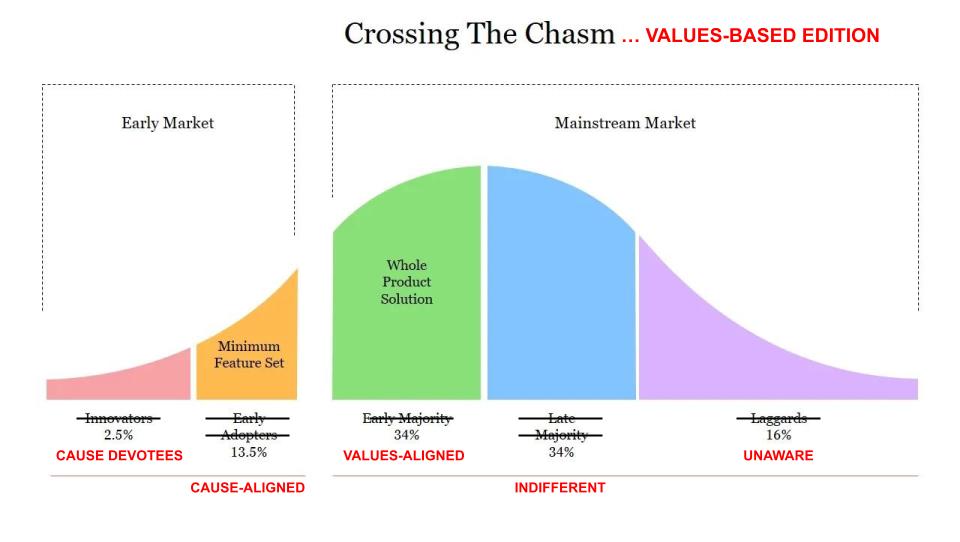
    Crossing the Adoption (Values) Chasm

    The classic technology adoption curve chart, modified with segments for values-based adoption amongst customers.

    One useful framework comes from Crossing the Chasm, a classic on technology adoption. In the early days, purpose-driven brands attract the most passionate supporters — those devoted to the cause. They’re your early adopters.

    But if you want to grow, you can’t stop there. To move beyond the early market, you need to appeal to people who are only loosely aligned with your values. That’s the “chasm” you need to cross.

    This is where many sustainability-driven founders stumble. They assume everyone cares about their mission as much as they do. The reality? Many customers don’t. They’ll support your purpose if it’s a bonus, but they’re really shopping for performance, price, comfort, durability, or convenience.

    That doesn’t mean your mission doesn’t matter — it does. But to build a broader customer base, you need to translate purpose into product benefits. Does your use of ocean plastics make your gear stronger? Lighter? More affordable? Those attributes are what help you move from cause-driven enthusiasts to mainstream buyers.

    Trust Matters : The Role of Certification

    One of the best ways to avoid accusations of greenwashing is third-party validation. Certifications provide a layer of credibility that customers can lean on when they don’t have the time or expertise to evaluate your claims themselves.

    Some relevant examples :

    • ISO 14001:2015 (Environmental Management)
    • Forestry Stewardship Council (FSC) certifications
    • CAN/BNQ 3840–100 for recycled plastics content
    • Certified B Corporation

    These aren’t just logos for your website. They force you to build systems of transparency and accountability internally — systems that strengthen your brand over the long run.

    And they communicate to customers that you’re serious. When people see a B Corp or FSC mark, they know you’ve been tested against a standard higher than “we promise.”

    Why Discounting Is a Trap

    Daniel also asked about discounting. It’s tempting for new brands to run constant promotions to move product and attract buyers. But here’s the problem : discounting trains customers to expect lower prices.

    There’s a saying I first heard at McDonald’s while working as a university student : deal loyalty isn’t real loyalty.

    If customers are loyal to your discount, not your brand, you’ve created a fragile business model. They’ll buy when there’s a sale, and they’ll wait when there isn’t. That erodes margins and traps you in a cycle that’s tough to escape.

    Instead of blanket discounts, think about controlled strategies :

    • Private sales tied to loyalty programs
    • Exclusive events where high-value customers get early or special access
    • Tiered rewards based on customer lifetime value

    Handled carefully, these approaches let you clear inventory or reward loyalty without undermining your brand equity.

    Translating Purpose Into Benefits

    Sourcing ocean-recovered plastics is a powerful purpose. But purpose alone won’t carry you across the chasm. The next step is translating that mission into practical value for customers.

    Ask yourself :

    • Does this material create a stronger or longer-lasting product?
    • Is it more comfortable or stylish?
    • Does it offer cost savings compared to traditional inputs?
    • Can I pass those savings to customers — or hold prices steady while competitors increase theirs?

    The answers help you frame your marketing in ways that resonate beyond your core cause. They also prepare you for mainstream retail, where shoppers are making side-by-side comparisons on shelves.

    Systems for Transparency

    Greenwashing accusations often boil down to opacity. Customers feel they don’t know what’s really happening behind the curtain. Transparency fixes that.

    Consider publishing impact reports, opening up about supply chains, or even creating customer-facing dashboards that track your progress toward sustainability goals. Patagonia does this exceptionally well, but smaller brands can do it too with the right tools.

    Transparency doesn’t mean perfection. In fact, being honest about challenges or trade-offs can build more trust than pretending everything is flawless.

    The Two Unbreakable Rules

    At the end of the day, the rules for avoiding greenwashing and building loyalty are simple :

    1. When you make a claim, back it up with evidence.
    2. When you make a promise, keep it.

    Everything else — certifications, storytelling, community-building — is an extension of these two commitments. Follow them consistently, and you’ll build the kind of trust that converts into loyalty over years, not months.

    Final Thoughts

    Daniel’s challenge is one that every purpose-based founder will face : how do you avoid greenwashing while still leaning into your purpose?

    The path forward is clear :

    • Translate your mission into tangible product benefits.
    • Use certifications to add credibility.
    • Resist the trap of deal-driven branding.
    • Build systems of transparency.
    • And above all, keep promises and back up claims with proof.

    If you do these things, your brand won’t just avoid the pitfalls of greenwashing. It will stand out as a leader in authenticity — something customers are hungry for in a world full of empty claims.

    Being green without greenwashing isn’t easy. But the rewards — a loyal customer base, a resilient brand, and a business that lives its values — are worth the effort.


    This article is a part of my series on topics for entrepreneurs, intrapreneurs, and people who just love building things. I podcast and post weekly with tools and guides on The Journey. Check out the companion piece and podcast here : https://6catalysts.substack.com/p/ama-being-green-without-greenwashing

  • [Medium] The Innovation Heartbeat

    [Medium] The Innovation Heartbeat

    The Innovation Heartbeat

    A Framework for Transforming Feedback to Insights

    Innovation. Few words in business carry as much baggage.

    It’s splashed across investor decks, marketing campaigns, and keynote speeches. It conjures up images of billion-dollar companies promising utopian futures : rockets to Mars, miracle drugs, AI revolutions. It’s become one of those flashy words that feels so overused it almost loses meaning.

    But here’s the truth : innovation doesn’t live only in those rarefied spaces. It isn’t limited to the domain of Silicon Valley titans, global pharma giants, or aerospace moonshots. Real innovation happens in everyday decisions, workflows, and problem-solving efforts. A process improvement that cuts wasted time? That’s innovation. A tweak to packaging that reduces errors? Innovation. A customer request turned into a new feature? Absolutely innovation.

    If that’s the case, why do so many organizations lose their innovative edge as they grow? Why do small, nimble startups brim with energy and creativity, while established organizations often feel like they’re stuck in slow motion?

    The answer is simple : ideas don’t disappear, but systems to process them break down.

    That’s where the Innovation Heartbeat comes in.

    It’s a framework designed to keep ideas circulating through your organization, just like blood circulates through the body. It ensures customer feedback, team suggestions, and everyday sparks don’t get lost but instead get refined and distributed into action.

    Innovation Is Everywhere

    Before we dive into the mechanics, let’s pause to reset our mental model of innovation.

    When your team is five people sitting around one table in a scrappy office above a coffee shop, innovation feels effortless. Someone says, “Hey, I was thinking…” and the conversation flows. Action happens quickly.

    As you scale, those conversations change. Teams specialize. Communication lines stretch. Priorities get stuck in silos. The urgency of execution crowds out the spark of ideas. The ecosystem that once carried ideas naturally starts to degrade.

    But innovation is not scarce. What’s scarce is the infrastructure to keep ideas alive.

    And here’s the shift : innovation has a supply chain, just like your products and services do.

    If you don’t build the pipes to move ideas around, they clog up. People stop sharing them. Execution carries on, but innovation slows down.

    The Innovation Heartbeat is that supply chain.

    The Framework in Three Phases

    The framework is straightforward : three phases that echo the way a human heart works.

    1. Pulse In : Reaching out to customers and gathering feedback.
    2. Fill & Process : Reviewing, filtering, and distilling feedback into insights.
    3. Pulse Out : Sharing those insights with stakeholders who can act on them.

    Let’s walk through each phase.

    Phase One : Pulse In

    The heartbeat starts with expansion. You open up, seeking signals from outside. In practice, this means building systems to collect customer feedback.

    Early on, that might mean sitting down for customer interviews, scanning support tickets, or picking up the phone. As you mature, automation becomes essential—surveys, feedback forms, in-product prompts, or tools like the Scalable Feedback Engine.

    The critical point here is consistency. Innovation thrives on rhythm. Without a steady inflow of signals, the system stalls.

    One word of caution : feedback collection must also respect customer privacy and choice. Regulations around personally identifiable information are evolving fast. More importantly, customers value companies that adopt a privacy-first mindset. Design your touchpoints in ways that invite openness, not suspicion.

    Phase Two : Fill & Process

    If Pulse In is about expansion, this phase is about circulation. Here, feedback enters the system and gets filtered into insights.

    Not all feedback is created equal. Some suggestions are directly actionable —change the way you package a product, fix a frustrating user interface. Others are guiding—signals about how well your company is meeting expectations, or where sentiment is shifting. Both types have value, but they play different roles.

    The Internal Champion — the person running the Innovation Heartbeat — leads this phase. Their job is to review, grade, and refine incoming feedback across four dimensions :

    1. Type : Is this actionable or guiding?
    2. Relevance : Does it align with the company’s mission, priorities, or customer focus?
    3. Impact : If implemented, how significant will the change be to customer experience?
    4. Difficulty : How complex would it be to execute the change?

    This grading system acts like gates in a pipeline. Weak ideas fall away; strong ideas advance. Some items may not be relevant today but are worth storing for later. The key is intentionality.

    Big ideas rarely survive this process unchanged — and that’s a good thing. They emerge sharper, contextualized, and ready for real impact.

    Phase Three : Pulse Out

    The final phase is contraction. This is where insights leave the center and move into the wider organization.

    Here’s the balancing act : while transparency is valuable, accountability matters even more. It’s tempting to dump insights into a shared folder or Slack channel and call it a day. But unless ownership is clear, nothing changes.

    The Internal Champion must not only distribute insights broadly but also hold purposeful conversations with stakeholders who can act. Marketing leaders may take one set of insights, product teams another. Each must know what they own and how to act on it.

    This is the critical transition : moving from raw ideas to real innovation.

    The Internal Champion : The Beating Heart

    At the center of this framework is the Internal Champion — the person who makes sure the heartbeat doesn’t falter.

    This role isn’t about seniority; it’s about capability and temperament. The most effective champions share four traits :

    • Intellectual Curiosity : A drive to dig into the “why” and connect dots others might miss.
    • Business Understanding : A working knowledge of products, services, and operations.
    • Communication Skills : The ability to translate feedback into insights people understand.
    • Tactful Assertiveness : Enough grit to advocate for customers, even when it’s unpopular.

    Champions don’t need to know how to do every specialized task. What matters is their ability to understand context and advocate across functions.

    If you find someone who fits this mold, protect and support them. They are rare — and they are catalysts for lasting innovation.

    Measuring the Heartbeat

    Like any system, the Innovation Heartbeat grows stronger when you measure it. Tracking the right metrics helps you refine and improve over time.

    Here are a few starters :

    • Time-to-Insight : How long does it take to turn feedback into a usable insight?
    • Conversion-to-Acceptance : What percentage of insights are adopted by stakeholders?
    • Time-to-Action : How long does it take to move from accepted insight to implemented change?
    • Grading Ratio : How many pieces of feedback does it take to generate one solid insight?
    • Customer Signal Trend : Are customer sentiment signals improving over time?

    These metrics don’t just measure speed or volume. They reveal where the system clogs and where it flows. Over time, they help you tune the Innovation Heartbeat to your organization’s unique rhythm.

    Why Start Early

    If building such a system sounds daunting, here’s the good news: it’s easier when your company is small.

    Large organizations often find meaningful change nearly impossible. Structures ossify. Politics creep in. Legacy systems resist new processes. By contrast, smaller companies can embed innovation into their DNA before complexity sets in.

    Think of it like fitness : it’s easier to build strength when you’re younger and more flexible. If you wait until later, the work is harder and the results slower.

    The Innovation Heartbeat is no different. Early adoption creates habits that scale with you.

    Innovation as a Competitive Moat

    Why does all this matter? Because innovation isn’t just a feel-good concept. It’s a competitive moat.

    Organizations that nurture curiosity, collect signals, and act on them consistently will outperform those that don’t. They’ll be faster, more responsive, and more in tune with customer needs.

    And the moat grows over time. Each cycle strengthens the system, making it harder for competitors to catch up.

    That’s why the Innovation Heartbeat is worth the investment. It’s not about chasing hype. It’s about creating an unfair advantage — one insight at a time.

    Putting It Into Practice

    Theory only takes you so far. That’s why I’ve built a free planning tool that helps you generate a tailored Innovation Heartbeat plan for your organization.

    It’s simple : answer a few questions about your size and resources, and the tool generates a plan. No data is saved, so you can answer freely. You can email yourself the output and start putting it into action right away.

    It takes about ten minutes — and it’s free. Your success is worth more to me than a few dollars. Get started here.

    Final Thoughts

    Innovation isn’t magic. It isn’t reserved for billion-dollar companies. It’s a discipline — a system that ensures ideas don’t die on the vine but flow into action.

    The Innovation Heartbeat provides that system. Pulse In. Fill & Process. Pulse Out.

    If you start small, measure consistently, and empower the right champion, innovation becomes more than a buzzword. It becomes part of your organization’s rhythm.

    And in the long run, that rhythm may be the strongest competitive advantage you can build.

    This article is a part of my series on topics for entrepreneurs, intrapreneurs, and people who just love building things. I podcast and post weekly with tools and guides on The Journey. Check out the companion piece here : https://6catalysts.substack.com/p/the-innovation-heartbeat

  • [MEDIUM] HOLY <BLEEP> : A Guide to Sales Forecasting

    [MEDIUM] HOLY <BLEEP> : A Guide to Sales Forecasting

    HOLY <BLEEP> : A Guide to Sales Forecasting

    Sales forecasting gets a bad rap. People call economics “the dismal science,” but if you’ve ever sweated over a quarterly sales forecast spreadsheet, you know forecasting deserves that crown.

    For many builders, it’s as nerve-wracking as public speaking. You dread it, you avoid it… until you’ve done it enough times to realize it won’t actually kill you. Like stepping on stage, the fear is mostly in the anticipation. The first time, your palms sweat. The second time, you’re still uneasy. By the tenth time, you start to notice patterns—and maybe even enjoy the craft.

    But forecasting for a business, especially if you make tangible products, is more than a comfort-building exercise. It’s a critical function that ties directly to your cash flow, inventory, and operational efficiency. It’s the Goldilocks problem in business operations: not too much, not too little, but just right. And getting there is hard.

    Even giant corporations with decades of experience, mountains of historical data, and advanced software tools routinely get it wrong. That’s why industries exist to deal with overstock—companies like Winners and Marshalls (TJX Group) or Liquidation World (LW Stores) profit from excess inventory created by forecasting misses.

    So, if the pros still struggle, how do you, the builder of a small but growing business, approach forecasting in a way that’s practical, effective, and doesn’t drain your will to live?

    Let’s start with the basics.


    What Forecasting Actually Is

    At its core, sales forecasting—also called demand forecasting—is making an educated bet on how many things your customers will buy in the future. You use that bet to place orders with suppliers, schedule production runs, or coordinate with a contract manufacturer (also called a co-packer) to make finished goods.

    It sounds simple enough, but in practice, it’s anything but. Forecasting requires balancing multiple variables: market demand, production capacity, seasonality, promotions, competitor activity, and your own risk tolerance.

    Forecasting accuracy is important because it directly impacts your most precious resources: time and money. A good forecast helps you optimize both.


    Why Forecasting Is Hard—and Why It Matters

    Forecast too low, and you risk running out of stock, losing sales, and frustrating customers. Forecast too high, and you tie up cash in unsold inventory that could have been invested elsewhere.

    Some leaders swear it’s better to under-forecast, keeping inventory lean to protect the cash conversion cycle. Others insist over-forecasting is safer, ensuring you never miss a sale. I think both views miss the point. Obsessing over whether you’re slightly over or under is less useful than creating a rational, data-informed process—and then setting guardrails so your worst-case scenario doesn’t sink you.

    Forecasting isn’t about perfection. It’s about creating a repeatable, adaptable system.


    The Three Main Forecasting Approaches

    Every forecast falls into one of three broad categories :

    1. Causal modelling — Looking at cause-and-effect factors that influence demand. This includes macroeconomic conditions (“Is the economy in recession?”) and micro factors (“We’re running a 20% off sale this month”). Price elasticity studies also fall here.
    2. Qualitative modelling — Using non-statistical information to build a picture of demand. This could be market research, surveys, or brand loyalty studies.
    3. Time-series modelling — Using your own historical demand data to predict future sales.

    For early-stage builders of tangible goods, time-series modelling is usually the most accessible and immediately useful approach. You don’t need a PhD in econometrics or expensive software—just a spreadsheet, some data, and a clear process.


    Four Time-Series Models You Can Start Using Today

    1. Historical Comparison

    The simplest method of all. Look at a comparable past period and assume you’ll sell the same amount in the future.

    If you sold 228 widgets in January this year, you forecast 228 for January next year. It’s quick, but it’s also blunt—it ignores growth, market changes, and promotional plans.

    Even with its limitations, historical comparison is foundational. It’s one of the few truly “known” data points you have.

    See an example here.


    2. Moving Average (MA)

    The moving average method smooths out short-term fluctuations to give a clearer view of overall trends. It’s more nuanced than a straight historical comparison because it reduces the impact of outlier months.

    Here’s how to build it:

    • Gather a year of sales data, broken down by time period (monthly is common).
    • Calculate the average for three consecutive periods (e.g., the last three months).
    • Use that three-period average as your forecast for the next period.

    This approach reduces volatility, but it still doesn’t account for predictable seasonal swings.

    See an example here.


    3. Seasonally-Adjusted Moving Average (SAMA)

    SAMA adds a layer to your moving average to capture predictable demand spikes or dips—like holiday shopping surges or summer slowdowns.

    To build it :

    • Identify recurring seasonal patterns in your sales data.
    • Calculate your moving average.
    • Determine the percentage lift or drop in sales during seasonal periods compared to non-seasonal ones.
    • Adjust your forecast accordingly.

    If you’re using a year-over-year historical comparison, seasonality is already baked in (though not as precisely as when you calculate it directly).

    See an example here.


    4. Exponentially-Smoothed Bursting

    This model is particularly useful for businesses that see intense demand spikes from promotions, PR pushes, or product launches—and for situations where you don’t have much historical data.

    The idea is to create a “demand curve” based on past bursts and apply it to future events.

    Steps :

    • Identify past bursts of activity and gather sales data for the periods before, during, and after.
    • Calculate your baseline sales.
    • Determine the sales lift (delta) during and after each burst.
    • Apply these lift percentages to forecast future bursts.

    This approach blends the smoothing benefits of moving averages with targeted adjustments for short-term, high-intensity demand patterns.

    See an example here.


    What If You Don’t Have Historical Data?

    Time-series models depend on past data. But what if you’re launching a new product or business and don’t have any?

    If you have a similar product, you can use its historical data as a proxy, adjusting for differences in audience, price point, or use case.

    If you have nothing, base your forecast on financial risk :

    • How much capital can you commit to production without jeopardizing your ability to try again if sales flop?
    • How confident are you in your product-market fit?
    • How deep are you willing to discount to move product if needed?

    Essentially, you work backwards from your risk tolerance. If you have $10,000 in operating capital and want to keep $5,000 in reserve, you produce as many units as the other $5,000 will buy. Launch, measure, adapt, repeat.


    The Continuous Improvement Mindset

    The most common forecasting mistake? Treating it as a static process. Businesses rarely track their forecast accuracy over time. They miss the opportunity to learn from misses and improve the model.

    Your forecasting process should evolve with your business. That means :

    • Reviewing actuals vs. forecasts regularly.
    • Identifying which models work best for which products.
    • Adjusting for new patterns as your business and market change.

    Even small improvements compound over time, boosting both your bottom line and your operational confidence.


    Forecasting as a Builder’s Superpower

    Forecasting isn’t glamorous. It doesn’t give you the immediate dopamine hit of closing a sale or launching a product. But it’s one of the most powerful tools in your operational toolbox.

    When done well, it frees up mental space. You’re not constantly scrambling to react to stockouts or overstock—you have a plan, and you trust the system you’ve built.

    That’s the real goal here : not perfection, but predictability. Not clairvoyance, but clarity.

    The best part? You can start today with nothing more than your sales data and a spreadsheet. Pick a model, apply it, measure your results, and keep refining. Over time, you’ll turn forecasting from a sweaty-palmed chore into a core strength of your business.


    This article is a part of my series on topics for entrepreneurs, intrapreneurs, and people who just love building things. I podcast and post weekly with tools and guides on The Journey. Check out the companion piece here : https://6catalysts.substack.com/p/holy-bleep-a-guide-to-sales-forecasting

  • [Medium] Survey Smarter : How to Turn Questions into Gold

    [Medium] Survey Smarter : How to Turn Questions into Gold

    Ask the right questions. Build the right things.

    An image of a market researcher conducting a focus group. The scene is a large conference room with a wooden table that the participants are sitting at.

    Listening as a Competitive Advantage : Gathering Feedback that Fuels Innovation

    You’ve probably heard the line :

    Good businesses talk to their customers.

    Great businesses listen to them.

    Exceptional businesses build around them.

    Heck, you might have heard it from me.

    So how do you actually do that?

    Recently, I wrote about the Scalable Feedback Engine— a system that helps you gather customer feedback in a structured, leveraged way as your business grows. But I didn’t get deep into the “how” of collecting feedback itself.

    This post is about that.

    Put the two pieces together, and you’ve got a working blueprint for using customer insights to fuel innovation in a repeatable, sustainable way.

    In August, I’ll also be dropping a free guided tool to help you build your own Scalable Feedback Engine from scratch. But for now, let’s talk about the first piece : gathering feedback.

    Walking the Talk (Literally)

    If you scroll to the bottom of any post in The Journey, you’ll see a simple request for feedback — and an anonymous link. Dozens of you have already weighed in. Thank you. I’m genuinely walking the walk here : most of the format changes you’ve seen in recent weeks came directly from your input.

    That’s part of my own feedback engine. Yours might look different, but the principle is the same:

    You have to start by asking questions — and making it easy for people to answer.

    But what questions should you ask?

    That’s where most builders get stuck.

    Anchor Your Questions in Purpose

    To get clear answers, you need clear intent. That means rooting your questions in purpose — and not just your organization’s, but also the purpose of the person who’ll use the insights.

    “Purpose” can mean a few things :

    • Organizational purpose — Why does your business exist?
    • Team or functional purpose — What’s this group here to accomplish?
    • Personal purpose — What impact are you, as a builder, trying to make?

    Let’s bring this into focus with a few examples.

    Context-Based Purpose in Action

    Ask yourself: Who is the stakeholder, and what are they trying to achieve?

    • Is it a delivery team leader trying to improve customer experience?
    • A product designer aiming to create better kitchen tools?
    • A sales leader trying to align messaging and pipeline?

    Each one of these people has a different lens. If you understand their purpose, you can craft better questions — and ask them at the right time, in the right way.

    Stay Focused, Damnit.

    Most first-time surveys are vague, catch-all monsters. One survey, 25 unrelated questions, blasted out to the entire list.

    You might get lucky with a few useful responses — but mostly, you’ll get noise.

    People don’t respond well to vague questions. They don’t have time to reason through what you’re trying to figure out.

    So help them.

    Create distinct feedback mechanisms for specific stakeholder–purpose pairings. Distribute them through relevant touchpoints. Use automation to reduce overhead — but always keep your questions purposeful.

    Here are a few quick Do This / Not That examples:

    Delivery Experience

    • DO THIS : Include a QR code to a feedback survey on the packing slip or delivery receipt.
    • NOT THAT : Ask about delivery experience as one of 30 questions in a generic annual marketing survey.

    Product Design

    • DO THIS : Go outside. Talk to 25 strangers. Ask what they love and hate about their kitchen counter setup.
    • NOT THAT: Ask your newsletter list to email you about their dream countertop.

    Sales Experience

    • DO THIS : Send a personal email survey to your 10 oldest and 10 newest customers. Ask what pain points you solved.
    • NOT THAT : Drop a Net Promoter Score link in your email signature and call it a day.

    Again, even the “Not That” options aren’t wrong — but they’re misaligned with purpose. Misalignment = missed opportunity.

    Touchpoints Matter

    Need inspiration? I put together a free resource: The Big Ol’ List of Feedback Touchpoints. No email required — just a Google Doc.

    Don’t default to the easiest channel. Choose the one most relevant to the audience and their journey.

    Rethinking Incentives

    Your superfans will give you feedback because they care. That’s great — but it only gets you so far.

    You’ll need to motivate folks outside your core circle too.

    Cash incentives and gift cards work — but they get expensive. Instead, get creative with the value you offer :

    • Game dev? Offer an exclusive skin or badge.
    • Coffee shop? Free coffee for a week if they complete the survey. Bonus: feature a new blend you’re testing.
    • eComm brand? Award loyalty points for participation.

    Think of it as a value exchange. You’re already asking them to trade money for your product — now offer a little value in return for their thoughts about it.

    Creating an Innovation Heartbeat

    Even the best survey in the world is worthless if it goes nowhere.

    Insights must be circulated, not just collected.

    That’s where the concept of an Innovation Heartbeat comes in :

    • Input phase : Feedback is gathered (heart expands)
    • Output phase : Insights are shared with decision-makers (heart contracts)

    This rhythm — like a literal heartbeat — keeps your organization healthy. It builds habits. It brings visibility to customer needs across departments. And it works no matter your company size.

    • Three-person team? Review feedback monthly as a group.
    • Three-hundred-person company? Break down meetings by stakeholder group. Set regular cadences.

    The key is routine. Feedback isn’t a one-off activity. It’s a pulse.

    Insights Fuel Innovation

    Innovation becomes exhausting when it’s solely the responsibility of the internal team. You already have a day job — brainstorming better ways to serve customers shouldn’t fall entirely on your shoulders.

    By integrating customer feedback into a scalable, habitual system, you lighten the load — and unlock a stream of outside-in thinking.

    You’re no longer guessing what customers want. You’re co-creating it with them.

    Final Thought

    The sooner you start, the easier it becomes to build a habit around feedback. And when feedback becomes habitual, so does innovation.

    And innovation? That’s how you stay relevant. It’s how you avoid being commoditized. It’s how you create the kind of business that’s hard to copy — and easy to love.

    Good businesses talk to their customers.

    Great businesses listen to their customers.

    Exceptional businesses build around them.

    Be that kind of business.

     — 

    This article is a part of my series on topics for entrepreneurs, intrapreneurs, and people who just love building things. I podcast and post weekly with tools and guides on The Journey. Check out the companion piece here : https://6catalysts.substack.com/p/survey-smarter-turn-questions-into-gold

  • [Medium] Working ON the Business

    [Medium] Working ON the Business

    Running your business isn’t the same thing as building your business.

    An image symbolizing the dual nature of a business owner working in the day to day of their business, but also ON the strategic growth planning for the business.

    Are You Working In the Business or On It? Here’s Why That Difference Matters More Than You Think

    You’re clocking 60+ hours a week. Your calendar is a war zone. You’re juggling operations, firefighting problems, and trying to keep your team motivated.

    But here’s the real question :

    Is your business actually growing the way you want it to?

    If the answer is no, it might be time to revisit a concept you’ve probably heard before :

    You need to work on the business, not just in the business.

    It’s a mantra passed around in entrepreneurial circles like gospel. But many founders misinterpret it — or ignore it — until they find themselves overwhelmed and off course.

    And here’s a nuance that’s rarely discussed : the more you distance yourself from the day-to-day, the more you risk losing touch with the soul of your company. Culture drifts. Vision fades. Momentum stalls.

    That’s not just a cautionary tale. It’s a reality for many builders who wake up one day and realize they’ve created something they don’t even recognize.

    Let’s unpack what it really means to work in the business versus on the business — and how to strike the balance that growth actually requires.

    Working In the Business

    When you’re working in the business, you’re embedded in the day-to-day. You’re in the weeds : running operations, solving customer problems, fixing bottlenecks, managing your team, and shipping the product.

    This is often called “Founder Mode,” and it’s gained a resurgence of popularity — especially after Paul Graham (of Y Combinator) rebranded it in 2024. Silicon Valley treated it like a revelation. But the truth is, leaders have been operating this way for decades. It’s not new — it’s just been repackaged.

    Working in the business isn’t a bad thing. In fact, there’s immense value in being present :

    • You build credibility with your team by showing up
    • You gain situational awareness that outsiders miss
    • You can solve problems quickly and directly

    It also aligns with servant-leadership principles — rolling up your sleeves and putting team success above your own comfort. Many of the best leaders I’ve known favor this style.

    But there’s a downside.

    When you’re too deep in the daily grind, it’s hard to maintain peripheral vision. You stop seeing the bigger picture. You miss strategic opportunities. You optimize for today instead of building for tomorrow.

    You can’t see the forest for the trees.

    And that’s a dangerous place to be when you’re responsible for shaping the future.

    Working On the Business

    This is where real growth happens.

    Working on the business means stepping back to think about how the business operates — and how it can improve. It’s about treating your company like a product : something to be iterated, optimized, and intentionally shaped.

    Instead of asking :

    “What task needs to be done today?”

    You ask :

    “How can we design this business to create happier customers, more effective teams, and better outcomes — at scale?”

    This mindset shift is powerful. It’s also uncomfortable, because it forces you to think like a system builder, not just a taskmaster.

    Let’s use a simple analogy.

    You already know that customers need things from your business — products, services, pricing, support.

    But have you considered that your employees are also customers? They need things from you, too :

    • Fair compensation
    • Clear direction
    • Tools that actually work
    • A sense of purpose
    • Room to grow

    When you start viewing employees as internal customers, everything changes. You begin managing them with the same intentionality you manage your external relationships. You start solving real problems — on both sides of the equation.

    And guess what?

    That’s the work of building a great business.

    How to Think Like a Builder (Not Just a Doer)

    When you’re working on the business, these questions become your compass :

    • How do we make this simpler?
    • How do we make this more effective?
    • How do we build our capacity to create happy customers?

    The answers might lead you to new systems, tools, team structures, or workflows. They might also highlight where you’re overcomplicating things or holding on to outdated processes.

    But here’s the key : when you treat this kind of work as a real project — with goals, milestones, and deliverables — you stop spinning your wheels and start building momentum.

    Why You Need to Do Both

    This isn’t an either-or situation.

    The best leaders switch between modes. They observe and participate, then zoom out and redesign.

    Working in the business helps you see what’s broken. Working on the business helps you fix it for the long term.

    One builds trust. The other builds systems.

    You need both to scale without losing your sanity — or your soul.

    How to Balance the Two (Without Burning Out)

    Yes, it’s possible to do both. But it’s hard. That’s why most people default to one or the other.

    Here’s what’s worked for me :

    Segment your time aggressively.

    • Spend 3 weeks each month working in the business
    • Reserve 1 week each month to work on the business
    • Protect that week like you would a meeting with your top client

    And when you do work on the business, treat it like any other strategic initiative. Document your plans. Write down your goals. Use a real framework — like SMARTER goals — to give your ideas structure.

    SMARTER stands for :

    Specific

    Measurable

    Actionable

    Relevant

    Timely

    Evaluated regularly

    Revised based on outcomes

    Final Thoughts

    If you’ve been buried in the day-to-day and growth feels stagnant, it’s time to step back.

    Not forever. Just long enough to see the forest again. To notice the friction points. To reconnect with your vision. And to ask : What’s really needed to move this business forward?

    Then, when you step back into the day-to-day, you’ll bring that clarity with you.

    Working in the business builds strength.

    Working on the business builds direction.

    Doing both makes you a builder worth following.

     — 

    This was originally posted as an article on my Substack, The Journey. You can check out the companion podcast episode there (links out to Spotify, Apple Podcasts, and YT Podcasts) : 

    https://6catalysts.substack.com/p/working-on-the-business-new