
-isms are everywhere. In the English language, we love to append -ism to a word in order to indicate that the word is a doctrine, theory, system… or practice… or a state of being, a condition, or a quality. “ism” was even its own word in the English language until the late 17th century. Today, just a suffix. “Just”. There’s a lot of weight attached to those three letters in the 21st century.
Given the modern context, where polarization seems to be sharpening, an ism is also a pretty reliable indicator that there are tribes attached to different camps that butt heads over the underlying context of the word. Racism. Sexism. Wokeism (hunh?). Communism. Socialism. Capitalism.
It’s all human tribalism.
See? Another ism.
Subconsciously, we organize ourselves around tribes. They give our brains context to anchor to a place in society — helping us to create groupings and units which shrink the vastness of human civilization into something which we can actually comprehend.
The cultural anthropologists in the room could do a much better job of elaborating on this that I can, but for our purposes — this is just context for what comes next.
Capitalism and commerce are not the same thing.
Though, they’re often linked together and the words are used interchangeably in some conversations. The nuance and the history of what each word represents is perhaps lost on people.
I’ve been thinking about the differences between them for several months now, after a stranger on the interwebs commented on one of my posts about organizational structure for small businesses and called me a fasciocapitalist [sic].
Fasciocapitalist, or fascio-capitalist, isn’t a recognized (ie, “real”) word. But, the implication and underlying meaning as I interpret it is that because I was openly discussing my experience and knowledge in a specific domain (private enterprise), and because this other person doesn’t like their own perception of that specific domain, then I must be part of a different (and hostile) tribe. And, that tribe is populated by fat-cat, wealthy fascists out to subsume or destroy the tribe that this person believes they belong to. Ergo, I’m a fascio-capitalist.
Not an accurate description of me as a person, and still not a word.
In retrospect, I was probably bantering with a bot. But, I had a glass of scotch in hand and some free time, so… meh?
But it did get me thinking, nonetheless.
Why do some people get so worked up about the words “socialism” and “capitalism”? Especially when there are precisely zero societies on the planet which practice pure capitalism or pure socialism? Every modern nation runs on a blend of policies and principles that can be classified as one or the other. Reality isn’t binary, in any of the ways which truly matter to society on a collective scale.
The United States isn’t a purely capitalist society. Unemployment insurance, medicare, and medicaid are socialist policies — and when the Federal Reserve acts as a lender of last resort or bails out corporations that are ‘too big to fail’, it does so with the preservation of capital in mind and the preservation of social systems (sorry about the paywall, the NY Times is clearly run by a bunch of capitalist punks).
Sweden isn’t a purely socialist society. There are limits to the state’s social safety net, and people freely exchange money for goods and services in shops — just like in every other country. Interestingly, Sweden is also a near-cashless society. Physical currency is largely eschewed in favour of electronic payment methods, in stark contrast to the experience down the road in Germany*. You could call this cashless dynamic a technocapitalist feature of Swedish society.
(that one’s also not a recognized word, but has at least been discussed intelligently through a lens of philosophical investigation).
What is Capitalism?
Capitalism, according to Oxford Reference :
an economic and political system in which a country’s trade and industry are controlled by private owners for profit.
So, we’re talking about the private ownership of enterprise with a purpose of generating profit (a proxy for resources, in the modern economy).
Not so bad, right?
People who bristle at the question I just asked, or those who have a visceral revulsion to the word capitalism are doing so due to their experience with the system. Especially the system of free-market capitalism. Free-market capitalism in its extreme is where profits begin to matter far more than the well-being of people.
Free-Market Capitalism, according to Oxford Reference :
an economic system where private individuals and corporations own the means of production (like factories and land) and where prices, production, and distribution are primarily determined by market forces (supply and demand) rather than government intervention. It emphasizes private property rights, competition, and the pursuit of profit as key drivers of economic activity.
The bolded emphasis above is where the problems with capitalism emerge. When bad actors operate within a framework featuring minimal constraints or interventions by government to protect people, generating profit becomes more important than the well-being of people due to systemic influences (or lack thereof).
Capitalism, and even free-market capitalism, is only as destructive as it is in the absence of a framework or code of conduct for ethical behaviour that places equal importance in the well-being of people (and planet, many would also say).
Capitalism doesn’t harm people. People using capitalism as an excuse to ignore the well-being of others is what harms people.
What is Socialism?
Again, according to Oxford Reference :
a political and economic theory or system advocating for collective** or governmental ownership and management of the means of production, distribution, and exchange, with the goal of benefiting all members of society.
So, ownership of enterprise by government(s) or collectives of people with a purpose of more or less equitably distributing the fruits of labour.
Personally, I can’t say that I buy into this completely — what’s the incentive for innovation and continuous improvement (“building things”) in the absence of the risk and reward of entrepreneurship? A moot point though, as there are no purely capitalist or purely socialist societies.
The notable part about socialism though, is the very end of the definition :
… with the goal of benefiting all members of society.
People who jive with the idea of socialism are actually jiving with that part, I believe. Equality and equity, and some assurance that their basic needs will be provided for even if circumstances beyond their control make a mess of their lives.
I really don’t care for the idea of total state control of enterprises, but I can certainly get behind the benefiting all members of society part. It’s not that conceptually different from buying insurance, or attending a potluck dinner.
The root of the really negative connotations about socialism can be found in this part of the definition :
… governmental ownership and management of the means of production …
Governments formed through democratic elections aren’t perfect. In the best-case scenarios, they’re barely adequate. Sometimes, they’re downright destructive. Personally, I believe that this is partly linked to the predominance of capitalism and the meritocratic attraction of the private sector (which is more illusion than reality, anyway). The “best and brightest” of society tend not to gravitate toward public sector organizations where innovative ideas and a desire for positive change are snuffed out by bureaucracy and below-market salaries***.
The memory of central economic planning and “equal” distribution of the fruits of labour under the USSR and eastern-European regimes in the twentieth century leaves many people with a bad taste in their mouth when they hear the words “communism” or “socialism”. So, like “free-market capitalism”, the bad experiences of people under these systems is a trigger for deeply-held revulsion.
And then, there are also people who simply just don’t understand what these terms actually mean and rely on the emotions and opinions of others to guide themselves toward a tribe which they think they should belong to.
We’ll leave that, at that.
OK, So What’s “Commerce”?
Leaning on Oxford Reference again :
the activity of buying and selling, especially on a large scale, and the exchange of goods and services, often between countries.
I’m not a big fan of this definition, as it has a very macroeconomic bend to it. Reading this in isolation of other contextual knowledge and experience, you would assume that countries and nation states are the primary buyers and sellers of goods — and that individuals, businesses, and small groups are irrelevant to commerce.
Intuitively, we know that this simply isn’t the case. Although international and domestic commerce involves nation states, trade amongst consumers and businesses is the lifeblood of commerce.
I prefer this definition of commerce :
the exchange of one thing of value for another thing of value.
Money has value. The pen on the shelf at the office supply shop has value. I’ll give them some money, they’ll give me that pen. Commerce.
Can We Finally Get to the Point?
Well yes, we just talked about the pen… didn’t we?
Sorry.
Here’s the non-inky point : capitalism requires commerce.
But commerce does not require capitalism.
In fact, capitalism (the term) is only around two hundred years old — the first references to it as an organized system date back to the early 1850s. The concept, though different from what we’d consider capitalism today, stretches back to the 1770s.
Commerce (not to be confused with mercantilism… ugh, another ism) is several millennia older. The earliest historical references that we’ve found for organized systems of trade date back over eight thousand years, to ancient Mesopotamia (modern-day Iraq).
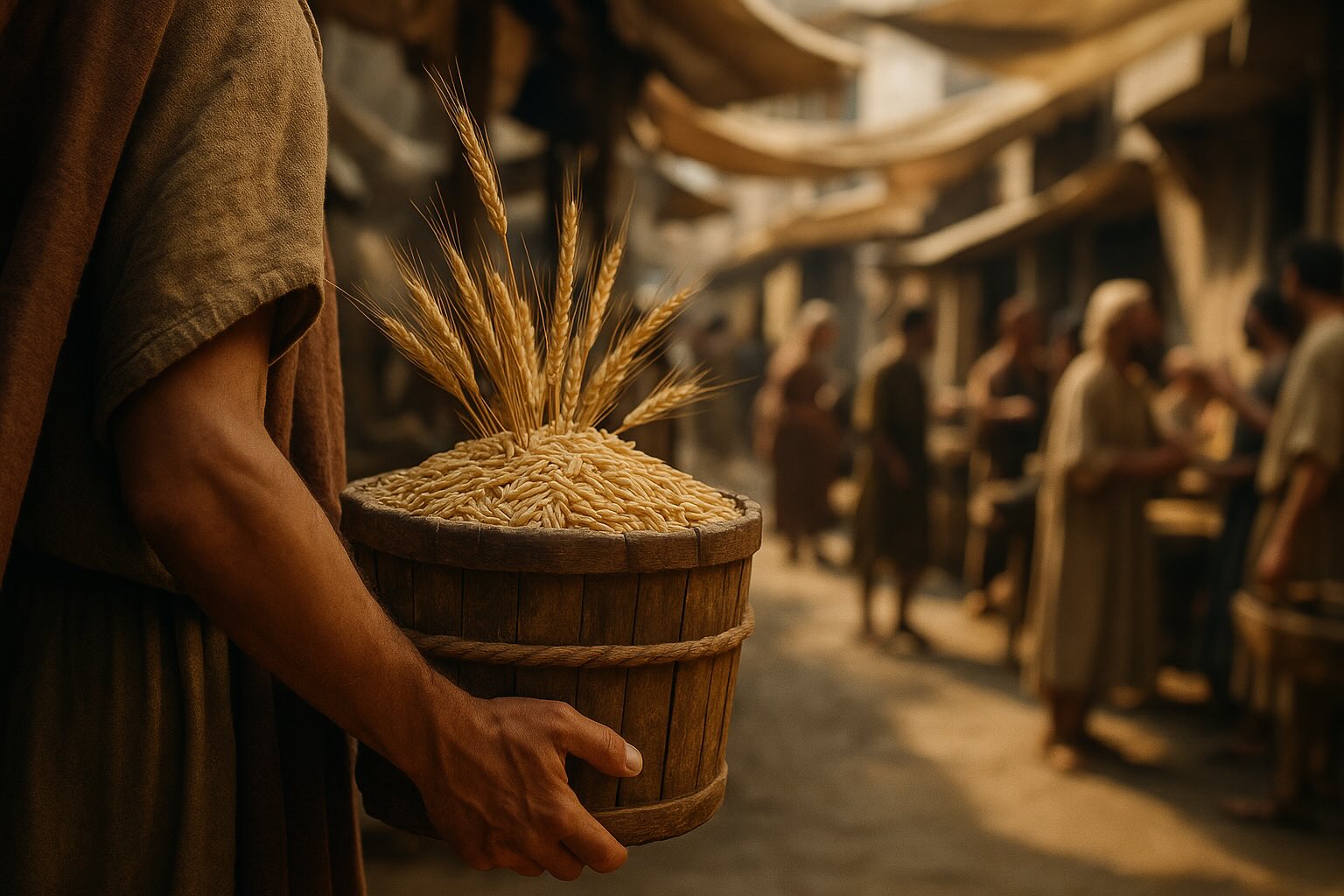
Nice looking barley bushels you’ve got there. I just so happen to have some top-notch ceramics over by my oxcart. Care to make a deal?
Commerce was originally barter.
By 3000 BCE, the ancient Phoenicians were trading a wide range of commodity and luxury goods back and forth across the Mediterranean. And, they were partly using forms of credit alongside a rudimentary precursor to the double-entry accounting system to power and scale the effectiveness of their commerce activities.
That’s just the recorded and recovered history, of course. It’s likely that human beings have been trading ever since we figured out how to walk upright. It’s an integral part of our experience… no one person (or business, or city, or nation) can produce everything that it needs in order to function optimally.
No Really, GET TO THE POINT!
Back to commerce does not require capitalism.
If we accept this concept, then we can also accept that running a business and engaging in commerce (an exchange of value) doesn’t have to mean generating profit at the expense of the well-being of people.
We can be engaged in private enterprise while treating employees, customers, and other stakeholders with fairness and equity. We can carry out commerce and choose not to prioritize profit at the expense of all else, simply because a system or a clash of cultures tells us that’s what our tribe does.
Maximizing profit above and beyond everything else is a choice. Not a necessity.
Just for Fun
People who identify as capitalists, especially free-market capitalists, are doing themselves (and collectively, the companies which they own) a disservice by fighting against certain “socialist” policies.
Namely :
- Universal healthcare (or rather, universal health insurance)
- Moderated collective bargaining
- Environmental protections aimed at preventing the indiscriminate pollution of air, water, and arable land
- Diversified and effective mass transit systems
- Affordable housing
- Affordable groceries and basic foodstuffs
Why?
It’s pretty simple.
Companies sell things. People buy things.
If people have less disposable income with which to buy things, companies will be able to sell fewer things. If there are fewer people, then there are fewer people to buy things. And companies will be able to sell fewer things.
In the extremes, that could even affect the viability of certain companies to carry on business. You might argue that this doesn’t matter for companies which sell to businesses or governments… but where do their economic resources come from? Other businesses — many of which derive their revenue from selling to consumers. And, in the case of governments, taxation. Which is ultimately derived from the activities of people.
A healthy economy isn’t just about the size of that economy (gross domestic product, or “GDP”). It’s also about the speed and reach with which capital resources (money) circulate through the economy, and are exchanged by people. Technically, GDP kind of measures this because GDP is a measure of transactions in aggregate, but it doesn’t do it very well or very holistically. Nor does it connect the dots between the velocity of and size or reach of capital very well.
An economy is the plumbing in a building. Money is the water which moves through the pipes, in order to reach the people who operate the taps.
Reduce the ability of the people to operate the taps to get the money, and the system can become one where the water doesn’t move… it just sits and stagnates. Economists call this “recession” or “depression” in the more drawn out cases (money not moving between market participants means fewer measured transactions, or, a “contraction in the GDP”).
Let’s bring it back to the things which self-proclaimed capitalists really should start liking :
Universal healthcare (or rather, universal health insurance)
Without this, people die earlier than they otherwise would. Or go bankrupt paying bills for medical treatment. In both cases, fewer people buying things.
Moderated collective bargaining
Without this, lower wages, meaning less disposable income with which to buy things.
Environmental protections aimed at preventing the indiscriminate pollution of air, water, and arable land
A sick environment creates sick people. In other words, fewer people and less disposable income with which to buy things.
Diversified and effective mass transit systems
How productive are you when stuck in traffic jams on the highway? What are you buying or selling from the middle of that gridlock? Not to mention that injury or death is statistically much more likely while travelling via a private automobile than on a mass transit system.
Affordable housing
The more expensive basic housing becomes, the less disposable income consumers have with which to buy things. This has become a significant problem in many western nations over the past five years in particular.
Affordable groceries and basic foodstuffs
Same as housing. The higher the share of income that consumers need to spend on foodstuffs, the less disposable income there is for discretionary purchases (ie fiddly shit that we don’t really need to live, but we kinda like buying). Not to mention that nutritional deficiencies are strongly correlated to health issues and premature deaths (exacerbated by weak or missing universal health insurance or substandard healthcare services).
TL;DR
If you like the idea of earning profits and making money, you should slide yourself closer to the socialism end of the spectrum than the capitalism end.
Sure, you’re less likely to become a billionaire. But is that really a requirement for living a long, healthy, personally-fulfilling life? You can’t take that money with you after you kick the bucket, after all.
I’m a terrible capitalist, as the above suggests — and I’m OK with that. Commerce doesn’t need capitalism. Neither does happiness.
— —
* I’m fully aware that Sweden and Germany aren’t geographic neighbours. But, I’m from Canada. The entire European Union could fit inside less than half of my country’s landmass. So from that perspective, Sweden and Germany are practically neighbours. And I have a terrible sense of humour.
** Collective ownership of ‘the means of production’ isn’t as weird or unwieldy as common narratives suggest. The Mondragon Corporation in the Basque region of Spain is the country’s seventh largest revenue-generator and employs 70,000 people. It’s been employee-owned since its founding in 1956. In many Commonwealth nations, special tax status exists for Employee Ownership Trusts — an increasingly popular vehicle for private owners who wish to retire to sell their companies to its employees.
*** Not that I’m intending to paint all governments and all public sector workers with such a dismal brush. There are some spectacular ones instilled with a deep sense of purpose and an orientation toward service to citizens and the desire to build a better society. I truly hope that the governance models which underpin the typical democracy can evolve over time to make you the norm and the apathetic cogs in the machine a rarity.
**** If you want to support my silly view of commerce over capitalism, head on over to The Journey on Substack and subscribe. It’s free, and it’s all about supporting entrepreneurs and people who want to build great things.