

Being Green Without Greenwashing
How Startups Can Build Trust and Authenticity
Building a brand is hard enough without extra baggage. But for founders creating purpose-driven businesses — especially those rooted in sustainability — the task gets heavier. Every story you tell, every promise you make, and every campaign you run comes with the risk of being dismissed as greenwashing.
Daniel, a founder in Vancouver, recently asked me a great question :
Marketing is something I’m struggling with. I don’t want to rely on discounting or “greenwashing” to build my startup’s brand. How can I tell our story in a way that’s authentic and builds a loyal customer base? I’m really stuck on how to use the ‘good’ parts of our sustainability philosophy without sounding insincere or preachy. Thanks, Daniel.
It’s a question that matters far beyond his industry. Any brand anchored in values — whether that’s sustainability, equity, or purpose — will eventually face the same test : how do you balance mission with pragmatism?
The answer requires us to break down greenwashing, look at the mechanics of trust, and explore practical strategies for building loyalty in a skeptical marketplace.
The Greenwashing Trust Gap
Let’s start with the obvious… greenwashing sucks.
When brands exaggerate or fabricate claims about sustainability, they break trust. And once trust is broken, it’s almost impossible to restore. I’ve felt this personally — when I learn a brand has played fast and loose with its claims, I don’t just avoid their products in the future. I hold a grudge.
What makes it worse is that dishonest players poison the well for everyone else. Consumers become skeptical. Even genuinely sustainable businesses are forced to work harder to “prove” themselves, often at greater cost and effort.
Without consistent regulation or global standards, startups are left in a tough position : how do you prove your claims when the market has been taught to doubt them?
Crossing the Adoption (Values) Chasm

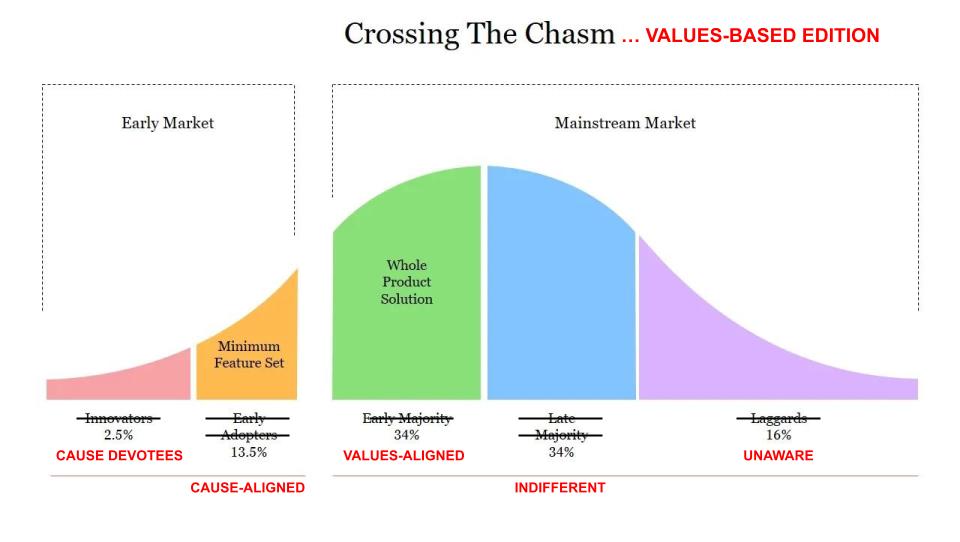
One useful framework comes from Crossing the Chasm, a classic on technology adoption. In the early days, purpose-driven brands attract the most passionate supporters — those devoted to the cause. They’re your early adopters.
But if you want to grow, you can’t stop there. To move beyond the early market, you need to appeal to people who are only loosely aligned with your values. That’s the “chasm” you need to cross.
This is where many sustainability-driven founders stumble. They assume everyone cares about their mission as much as they do. The reality? Many customers don’t. They’ll support your purpose if it’s a bonus, but they’re really shopping for performance, price, comfort, durability, or convenience.
That doesn’t mean your mission doesn’t matter — it does. But to build a broader customer base, you need to translate purpose into product benefits. Does your use of ocean plastics make your gear stronger? Lighter? More affordable? Those attributes are what help you move from cause-driven enthusiasts to mainstream buyers.
Trust Matters : The Role of Certification
One of the best ways to avoid accusations of greenwashing is third-party validation. Certifications provide a layer of credibility that customers can lean on when they don’t have the time or expertise to evaluate your claims themselves.
Some relevant examples :
- ISO 14001:2015 (Environmental Management)
- Forestry Stewardship Council (FSC) certifications
- CAN/BNQ 3840–100 for recycled plastics content
- Certified B Corporation
These aren’t just logos for your website. They force you to build systems of transparency and accountability internally — systems that strengthen your brand over the long run.
And they communicate to customers that you’re serious. When people see a B Corp or FSC mark, they know you’ve been tested against a standard higher than “we promise.”
Why Discounting Is a Trap
Daniel also asked about discounting. It’s tempting for new brands to run constant promotions to move product and attract buyers. But here’s the problem : discounting trains customers to expect lower prices.
There’s a saying I first heard at McDonald’s while working as a university student : deal loyalty isn’t real loyalty.
If customers are loyal to your discount, not your brand, you’ve created a fragile business model. They’ll buy when there’s a sale, and they’ll wait when there isn’t. That erodes margins and traps you in a cycle that’s tough to escape.
Instead of blanket discounts, think about controlled strategies :
- Private sales tied to loyalty programs
- Exclusive events where high-value customers get early or special access
- Tiered rewards based on customer lifetime value
Handled carefully, these approaches let you clear inventory or reward loyalty without undermining your brand equity.
Translating Purpose Into Benefits
Sourcing ocean-recovered plastics is a powerful purpose. But purpose alone won’t carry you across the chasm. The next step is translating that mission into practical value for customers.
Ask yourself :
- Does this material create a stronger or longer-lasting product?
- Is it more comfortable or stylish?
- Does it offer cost savings compared to traditional inputs?
- Can I pass those savings to customers — or hold prices steady while competitors increase theirs?
The answers help you frame your marketing in ways that resonate beyond your core cause. They also prepare you for mainstream retail, where shoppers are making side-by-side comparisons on shelves.
Systems for Transparency
Greenwashing accusations often boil down to opacity. Customers feel they don’t know what’s really happening behind the curtain. Transparency fixes that.
Consider publishing impact reports, opening up about supply chains, or even creating customer-facing dashboards that track your progress toward sustainability goals. Patagonia does this exceptionally well, but smaller brands can do it too with the right tools.
Transparency doesn’t mean perfection. In fact, being honest about challenges or trade-offs can build more trust than pretending everything is flawless.
The Two Unbreakable Rules
At the end of the day, the rules for avoiding greenwashing and building loyalty are simple :
- When you make a claim, back it up with evidence.
- When you make a promise, keep it.
Everything else — certifications, storytelling, community-building — is an extension of these two commitments. Follow them consistently, and you’ll build the kind of trust that converts into loyalty over years, not months.
Final Thoughts
Daniel’s challenge is one that every purpose-based founder will face : how do you avoid greenwashing while still leaning into your purpose?
The path forward is clear :
- Translate your mission into tangible product benefits.
- Use certifications to add credibility.
- Resist the trap of deal-driven branding.
- Build systems of transparency.
- And above all, keep promises and back up claims with proof.
If you do these things, your brand won’t just avoid the pitfalls of greenwashing. It will stand out as a leader in authenticity — something customers are hungry for in a world full of empty claims.
Being green without greenwashing isn’t easy. But the rewards — a loyal customer base, a resilient brand, and a business that lives its values — are worth the effort.
This article is a part of my series on topics for entrepreneurs, intrapreneurs, and people who just love building things. I podcast and post weekly with tools and guides on The Journey. Check out the companion piece and podcast here : https://6catalysts.substack.com/p/ama-being-green-without-greenwashing